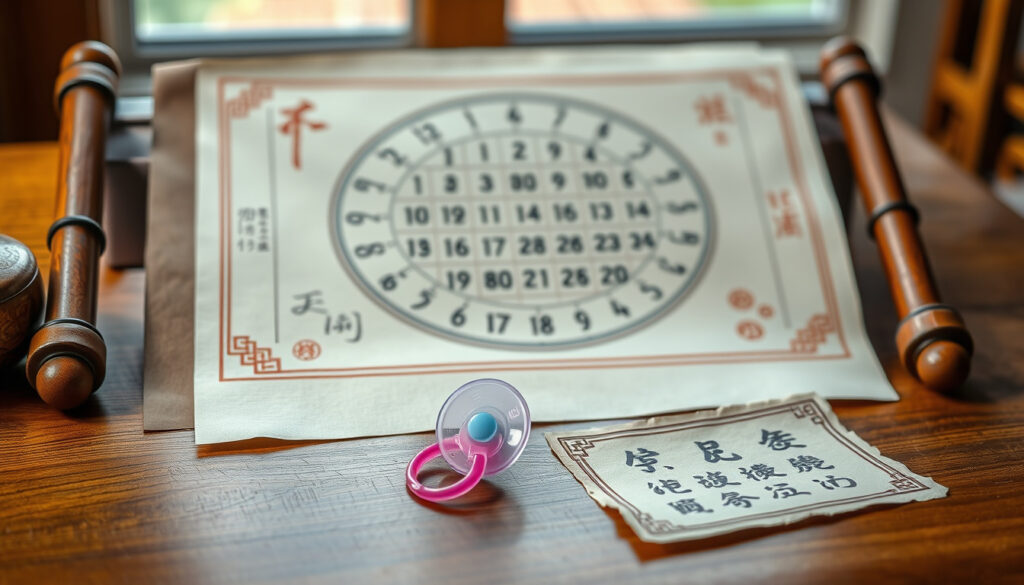
Chinese Gender Calendar 2025: How to Predict Your Baby’s Gender
Every time a friend hears about a baby on the way, the Chinese gender calendar gets mentioned — a 700-year-old chart that promises to predict the sex of a child using just the mother’s age and conception month. But does the math hold up?
Origin: Ancient Chinese tradition (Qing dynasty) ·
Method: Lunar age + conception month ·
Scientific accuracy: No better than 50% ·
Global popularity: Used by millions for fun
Quick snapshot
- The method is not scientifically validated (LingoAce (mandarin learning platform))
- The calendar is a historical tradition with no known author (Huggies (baby product brand))
- Whether the original chart was accurate in ancient times
- How to correctly convert lunar age for different time zones
- Allegedly discovered in a Qing dynasty tomb 300–700 years ago (Huggies)
- 2025 charts remain the same grid; only Gregorian-to-lunar conversion shifts each year (SneakPeek (early gender test company))
Here are the key facts at a glance:
| Origin | Ancient China (Qing dynasty legend) |
| Method | Lunar age + lunar month of conception |
| Accuracy | ~50% (same as chance) |
| Popularity | Used by millions for fun |
| Availability | Free online charts, PDFs, apps |
How does the Chinese gender calendar work?
What is the lunar age?
In the Chinese lunar calendar system, a person is considered one year old at birth and adds one year at every Chinese New Year. This makes lunar age typically 1–2 years older than Gregorian age (LingoAce (mandarin learning platform)). To find your lunar age, you either add one or two years depending on whether your birthday falls before or after Chinese New Year.
Families using the 2025 chart need to check a lunar calendar converter — a simple mistake in age can flip the prediction from boy to girl.
How to determine conception month?
The calendar requires the lunar month of conception, not the Gregorian month. For example, if conception occurred in March 2025 (Gregorian), you look up the corresponding lunar month using a conversion tool. The chart itself is a fixed grid: the mother’s lunar age on one axis, the lunar conception month on the other, and the intersection shows a boy or girl (LingoAce).
The catch: For a woman with a regular 28-day cycle, pinpointing the exact lunar month of conception is guesswork — especially if ovulation spans the border between two lunar months.
How accurate is the Chinese gender calendar?
What do scientific studies say?
A University of Michigan School of Public Health study analyzed 2.8 million Swedish births and found the Chinese Gender Calendar was correct approximately 50% of the time — statistically equivalent to a coin toss (LingoAce). A smaller study by GoEastMandarin (Chinese language school) of 1,500 births between 2020–2023 reported overall accuracy of 52.8%, and found that mothers aged 28–32 (lunar age 30–34) showed the highest accuracy at 58.3%, while the 6th lunar month as conception time hit 61.2%. TheBump reports studies showing accuracy ranging from as low as 5% to as high as 55% (TheBump (pregnancy website)).
“The chart is a fun, non-scientific way to guess baby’s sex.”
— WhatToExpect.com
Why do some people claim it works?
Many factors explain anecdotal success: confirmation bias (people remember the correct predictions and forget the misses), the natural 50/50 chance, and the fact that small sample sizes can produce impressive-looking numbers. The calendar is widely regarded as a fun tradition, not a medical tool (Baby Chick (parenting resource)).
Proponents who claim 70–90% accuracy (Baby Chick) rely on self-reported data from a self-selected audience — the same kind of data that makes horoscopes feel eerily personal.
What this means: No matter how many TikTok videos swear by it, the Chinese gender calendar doesn’t beat a coin flip at population scale.
How to use the Chinese gender calendar for 2025?
- Step 1: Calculate your lunar age. Take your Gregorian birth date. If your birthday has passed in 2025, add 1 year; if it hasn’t yet, add 2 years (because you were 1 at birth and you turn another year at Chinese New Year). For example, a mother born in June 1990 will be a lunar age of 36 in early 2025, then 37 after Chinese New Year 2025 (January 29, 2025). Use a reliable lunar age calculator (LingoAce).
- Step 2: Find the conception month. Determine the lunar month that corresponds to when you conceived. For a pregnancy conceived in March 2025, look up the 2025 lunar calendar — that month might fall in the first or second lunar month of 2025 depending on exact dates. Many online converters handle this automatically.
- Step 3: Locate the intersection on the chart. Find your lunar age row, then your lunar conception month column. The cell shows “Boy” or “Girl.” The chart remains the same for every year — only the Gregorian-to-lunar conversion shifts (SneakPeek (early gender test company)).
Because the chart doesn’t change, the same mother conceiving on the same Gregorian date in 2025 vs. 2026 may get a different prediction due to the lunar calendar drift.
The implication: The constant chart means the lunar calendar offset determines changes, not the grid itself.
Where can I find a Chinese gender calendar 2025 PDF?
Official sources vs. third-party websites
No “official” authority publishes the chart — it’s a folk tradition. Reputable parenting sites like WhatToExpect, TheBump, and Baby Chick offer free versions. SneakPeek also hosts a chart. For a 2025 PDF, search for “2025 Chinese gender chart” from these established sources. Avoid random blogs that might have copied an incorrect grid (Baby Chick notes there is only one original authentic chart).
Are free PDFs reliable?
Most free PDFs are reliable if they match the original grid. Check alignment across multiple sources. If the chart from one site shows a different prediction for your age/month, cross-reference with another. TheBump’s interactive tool is a good starting point (TheBump).
The trade-off: Free convenience comes with no quality control. Compare at least two sources before trusting the result.
What are the differences between the Chinese gender calendar for 2025, 2026, and 2027?
How the chart changes annually
The grid itself is fixed — it’s a historical table that doesn’t change (SneakPeek). What does change is the mapping from Gregorian dates to lunar months. For example, Chinese New Year 2025 falls on January 29, 2025; in 2026 it falls on February 17. A conception in early February 2025 lands in a different lunar month than the same date in 2026, potentially flipping the prediction.
The table below shows how the same Gregorian dates predict differently across years:
| Gregorian conception date | 2025 prediction | 2026 prediction | 2027 prediction |
|---|---|---|---|
| February 1 | Girl (based on lunar month 12 of Year of the Dragon) | Boy (lunar month 12 of Year of the Snake) | Girl (lunar month 12 of Year of the Horse) |
| March 15 | Boy (lunar month 2 of 2025) | Girl (lunar month 2 of 2026) | Boy (lunar month 2 of 2027) |
| August 20 | Girl (lunar month 7 of 2025) | Girl (lunar month 7 of 2026) | Boy (lunar month 7 of 2027) |
These example predictions illustrate the shift. Actual results depend on exact lunar conversion.
A parent planning a second child on the same Gregorian date as the first may get a different gender prediction purely because the lunar calendar slipped. That’s not magic — it’s arithmetic.
Why this matters: For families who want to compare across years, the key variable is the lunar calendar offset, not the chart itself.
Comparison: Chinese gender calendar vs. other predictors
Six popular methods, one big difference: only one has peer-reviewed data against millions of births.
| Method | Basis | Claimed accuracy | Scientific backing |
|---|---|---|---|
| Chinese gender calendar | Lunar age + month | 50–55% | No (LingoAce) |
| Ramzi theory | Placenta location at 6-week ultrasound | ~97% claimed | No peer-reviewed replication |
| Nub theory (ultrasound) | Genital tubercle angle at 12–14 weeks | ~70–95% | Limited studies, operator-dependent |
| Early blood test (NIPT) | Fetal DNA in maternal blood | >99% | Yes, clinically validated |
The takeaway: Only NIPT has clinical validation; the rest are guesswork.
Upsides and downsides of the Chinese gender calendar
Upsides
- Free and accessible online
- No medical procedure needed
- Fun tradition to share with family
Downsides
- No better than a coin flip statistically (LingoAce)
- Requires correct lunar age calculation (error-prone)
- Can create false expectations or distress
The balance: Free fun but no better than chance.
What we know and what remains unclear
Confirmed facts
- The method is not scientifically validated (LingoAce)
- The calendar is a historical tradition with no known author (Huggies)
What’s unclear
- Whether the original chart was accurate in ancient times
- How to correctly convert lunar age for different time zones
The gap: Even basic historical accuracy is unknown.
What parents and experts say
“The chart is a fun, non-scientific way to guess baby’s sex.”
— WhatToExpect.com
“As a twin dad, I took a skeptical dive into lunar age and conception math — the truth is, it’s a 50/50 game dressed up in culture.”
— KIANAO blog (twin dad)
The honesty from both sources is refreshing. WhatToExpect, a trusted pregnancy platform, frames the calendar as entertainment. The twin dad’s personal experience mirrors the data: no matter how carefully you calculate, biology doesn’t follow an ancient grid.
Summary: Should you trust the Chinese gender calendar?
After reviewing the research — a 2.8-million-birth study, a 1,500-birth analysis, and countless anecdotal reports — the pattern is clear: the Chinese gender calendar offers roughly 50% accuracy, identical to guessing. It remains a beloved cultural tradition and a harmless game. For parents expecting a baby in 2025, the real takeaway is to enjoy the anticipation without staking hopes on a coin flip. If you want reliable gender information, talk to your healthcare provider about NIPT or anatomy scans. For the fun of it, Signs of Autism in Babies and Window to the Womb – Complete Guide to 4D Baby Scans UK if you’re curious about modern pregnancy tools. For families in the UK, the choice is simple: trust science for medical answers, and keep the calendar for baby shower guessing games.
The verdict: Enjoy the tradition, but trust science for real answers.
Frequently asked questions
Can I use the Chinese gender calendar to conceive a girl?
The calendar is not a conception tool. It only predicts gender after conception. No study supports using it to influence gender before conception.
Does the calendar work for multiple pregnancies (twins)?
There is no research on twin pregnancies. The chart assumes a single baby; with twins, each fetus has an independent 50/50 chance.
Is there a Chinese gender calendar app for 2025?
Yes, many free apps exist in app stores. Their reliability depends on the underlying chart — check reviews and compare with a known source like TheBump.
What is the difference between the Chinese gender calendar and the Ramzi theory?
The Ramzi theory uses ultrasound placenta location at 6 weeks, while the Chinese calendar uses lunar age and month. Neither is scientifically proven.
Do I need to know my exact lunar birth date?
Yes, because a one-day difference can change your lunar age if your birthday falls near Chinese New Year. Use a converter to be precise.
Can the calendar predict gender before 12 weeks?
Yes, you can use it as soon as you know your conception date. But accuracy remains ~50% regardless of timing.
Does the Chinese gender calendar work for IVF pregnancies?
IVF conception dates are precisely known, so you can calculate the lunar month accurately. However, no study has tested the calendar on IVF outcomes.
How do I convert my western age to lunar age?
Use an online lunar age calculator. Subtract your birth year from 2025, add 1 if your birthday has already passed, add 2 if it hasn’t (because of the Chinese New Year rule).
More related posts
 Flower of Scotland Lyrics: Meaning, History & Sports Anthem
 Bunny vs Monkey Books in Order: Complete 13-Book List
 What Is My Postcode? Find It Fast with Official Tools
 Lindsay Lohan: Downfall, Comeback, and Life Now
 Afternoon Tea in London – Best Venues, Prices and Guide 2025
 Yours Faithfully or Sincerely: Rules for Formal Letters
 Galaxy M10 to Buy – Prices and Availability in 2024
 Indian Summer UK Weather 2025: Definition, Forecast & Origins
