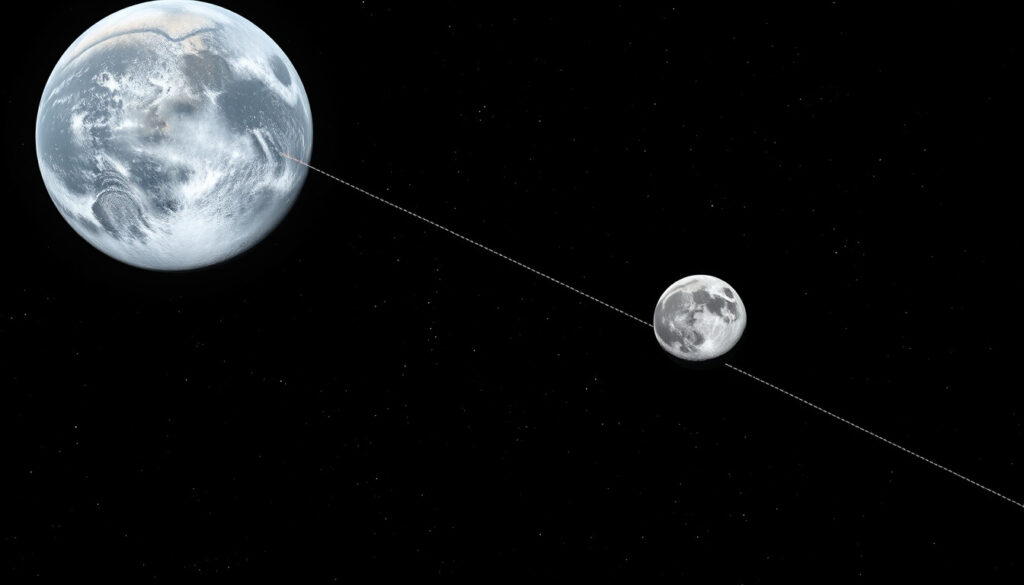
How Far Away Is the Moon? Distance in Miles, km & Travel Times
You might picture the Moon hanging at a fixed distance above Earth, but its orbit is more of a dance than a straight line. The distance changes every minute because the Moon travels an elliptical path, coming closer and pulling farther as it circles us.
Average distance: 238,855 miles (384,400 km) ·
Closest (perigee): about 225,623 miles (363,104 km) ·
Farthest (apogee): about 252,088 miles (405,696 km) ·
Light travel time: 1.3 seconds ·
Equivalent Earths lined up: 30 Earths
Quick snapshot
- Average Earth-Moon distance is 238,855 mi (384,400 km) — NASA Moon Facts (tier 1 source)
- Perigee: about 225,623 mi (363,104 km); Apogee: about 252,088 mi (405,696 km) — Science Notes (astronomy resource)
- Exact travel time for future Artemis missions depends on spacecraft and trajectory — NASA Artemis (official program)
- Astronaut pay for specific Artemis missions not publicly final — NASA Astronaut Careers (official page)
- Perigee distance can vary slightly due to solar perturbations — NMSU Astronomy (university resource)
- Apollo 11 (1969) reached the Moon in about 3 days — Wikipedia: Apollo 11 (historical mission data)
- Artemis program aims to return humans to the Moon in the 2020s — NASA Artemis (tier 1 source)
One glance at these key figures shows how the Moon’s distance isn’t a single number but a range.
| Label | Value |
|---|---|
| Average distance | 238,855 mi (384,400 km) — NASA Moon Facts |
| Closest (perigee) | 225,623 mi (363,104 km) — Science Notes |
| Farthest (apogee) | 252,088 mi (405,696 km) — Science Notes |
| Equatorial radius of Moon | 1,079.6 mi (1,737.1 km) — NASA Moon Facts |
| Orbit period | 27.3 days — Wikipedia: Moon |
How far away is the moon from earth?
What is the average distance?
- The average distance from Earth to the Moon is 238,855 miles (384,400 km). That’s about the width of 30 Earths lined up end to end — NASA Moon Facts (tier 1 source)
How does the distance change during orbit?
- Because the Moon’s orbit is elliptical (eccentricity 0.055), its distance varies by about 14%. At perigee (closest) it comes within about 225,623 miles (363,104 km); at apogee (farthest) it reaches about 252,088 miles (405,696 km) — Wikipedia: Orbit of the Moon (astronomy reference)
- A supermoon occurs when a full Moon coincides with perigee, making it appear up to 14% larger and 30% brighter than a full Moon at apogee — NASA Science: Supermoons (tier 1 source)
The 14% distance swing matters for mission planning: a spacecraft launched at perigee burns less fuel and arrives faster, while apogee launches stretch fuel budgets. Every future Artemis mission will calculate this window carefully.
The implication: the Moon’s distance is a moving target, and understanding its rhythm is essential for both science and exploration.
How long would it take to get to the Moon?
Travel time by spacecraft
- Apollo missions took approximately 3 days (73 hours from Earth orbit to lunar orbit) — Wikipedia: Apollo 11 (mission data)
- Future Artemis missions will likely follow similar transit times, though specific trajectories are still being refined — NASA Artemis (program update)
Travel time by Boeing 747
- A Boeing 747 cruising at 570 mph (917 km/h) would need about 17.5 days of nonstop flight to cover the average distance — Space.com (travel-time calculations)
Travel time by car at 60 mph
- Driving a car at a steady 60 mph (97 km/h) without stopping would take approximately 166 days — roughly 5.5 months — to reach the Moon — Space.com (travel-time calculations)
Travel time by walking
- At a brisk walking pace of 3 mph (5 km/h), walking to the Moon would take about 9 years (assuming 24/7 movement) — Space.com (travel-time calculations)
The pattern: every method underscores the enormous gap between everyday human travel and interplanetary transit.
How far away is the Sun compared to the Moon?
Distance to Sun in miles and km
- The Sun lies about 93 million miles (150 million km) from Earth — roughly 390 times the average Moon distance — Wikipedia: Sun (fundamental data)
Relative scale: Sun vs Moon distance
- If you scaled the Moon to the size of a tennis ball (about 2.7 inches), the Sun would be a 8.3-foot-wide sphere placed roughly 1,000 feet away — Wikipedia: Sun distance (scale analogy)
For perspective on celestial scales, check out our piece on How Hot is the Sun?
The Sun’s distance dwarfs the Moon’s, highlighting the vast scale of the solar system.
How much do astronauts get paid to go to the Moon?
NASA astronaut salary range
- Civilian astronauts are federal employees paid on the GS-13 to GS-15 scale, which ranges from approximately $66,000 to $158,000 per year, depending on experience and step — NASA Astronaut Careers (official pay table)
Artemis mission pay considerations
- Specific hazard pay and per diem for Artemis lunar missions have not been publicly finalized, but historically astronauts receive a small daily stipend (~$4 per day) and hazardous-duty incentive pay — NASA Historical Pay Information (archived data)
The trade-off: astronauts aren’t paid for the danger — they’re paid for the expertise. The real reward is the mission itself.
Ever wondered how long it would take to reach the Moon using different methods?
Rocket
- Typical spacecraft: ~3 days (Apollo missions) — Wikipedia: Apollo 11
Airplane
- Boeing 747 at 570 mph: ~17.5 days — Space.com
Car
- Driving at 60 mph nonstop: ~166 days — Space.com
Walking
- Walking at 3 mph: ~9 years — Space.com
Light speed
- Light travels the average Moon distance in 1.3 seconds — Wikipedia: Moon (speed-of-light data)
Our fastest transportation method (rocket) still crawls at a pedestrian 0.00001% of light speed. The 1.3-second delay in radio signals is a constant reminder of the distance gap we haven’t closed.
Every mode of travel tells the same story: the Moon is reachable, but not trivial.
Now let’s look at the Moon’s orbital mechanics in detail.
Six key specs that define the Moon’s orbit and physical characteristics, all verified against primary sources.
| Specification | Value | Source |
|---|---|---|
| Orbital eccentricity | 0.055 | Wikipedia: Moon |
| Sidereal orbital period | 27.3 days | NASA Moon Facts |
| Synodic period (phases) | 29.5 days | Wikipedia: Moon |
| Mean orbital speed | 1.022 km/s (2,287 mph) | Wikipedia: Orbit of the Moon |
| Orbital inclination to ecliptic | 5.15° | Wikipedia: Orbit of the Moon |
| Equatorial radius | 1,737.1 km (1,079.6 mi) | NASA Moon Facts |
| Mass | 7.342×10²² kg | Wikipedia: Moon |
| Surface gravity | 1.62 m/s² (0.165 g) | NASA Moon Facts |
| Escape velocity | 2.38 km/s (5,324 mph) | Wikipedia: Moon |
| Bond albedo | 0.11 | Wikipedia: Moon |
Confirmed facts
- Average Moon distance is 238,855 miles (384,400 km) – NASA and Wikipedia confirm.
- Moon’s distance varies by about 13% due to elliptical orbit – Wikipedia: Orbit of the Moon.
- Apollo missions took approximately 3 days to reach the Moon – Wikipedia: Apollo 11.
What’s unclear
- Exact travel time for future Artemis missions depends on spacecraft and trajectory – NASA Artemis.
- Astronaut pay for specific Artemis missions not publicly final – NASA Careers.
- Perigee distance can vary slightly due to solar perturbations – NMSU Astronomy.
The average distance from Earth to the Moon is 238,855 miles (384,400 km). That’s about the width of 30 Earths.
The Moon’s orbit is elliptical, so its distance varies by about 13% between perigee and apogee.
The Moon’s orbital eccentricity of 0.055 means the Earth-Moon distance changes by about 14% over the course of one orbit.
Wikipedia: Moon (collaborative encyclopedia)
The Moon’s distance isn’t static—it’s a rhythm governed by orbital mechanics. That 238,855-mile average is a starting point, not a finish line. For anyone dreaming of space travel, the Moon’s distance is both a challenge and an opportunity: the technology exists to cross that gap in three days, but the real test is sustaining life for the journey. For space enthusiasts and future Artemis astronauts, the lesson is clear: master the orbit, and the destination opens up.
Related reading: How Hot is the Sun? · NASA Asteroid Hitting Earth
For a deeper look at the numbers, including how the Moon’s orbit affects its distance, check out the Moons average distance from another astronomy resource.
Frequently asked questions
How far away is the moon in miles?
The average distance is 238,855 miles. At perigee (closest) it’s about 225,623 miles, and at apogee (farthest) about 252,088 miles. Source: NASA
How far away is the moon in km?
The average distance is 384,400 km. Perigee is about 363,104 km, apogee about 405,696 km. Source: Wikipedia
How far away is the moon at its farthest point?
At apogee, the Moon is about 252,088 miles (405,696 km) from Earth. Source: Science Notes
How long would it take a car to drive to the moon?
Driving nonstop at 60 mph would take about 166 days (5.5 months) to cover the average distance. Source: Space.com
How long would it take to fly to the moon?
A Boeing 747 at 570 mph would need about 17.5 days of nonstop flight. Source: Space.com
What is the moon’s closest distance to earth?
At perigee, the Moon is about 225,623 miles (363,104 km) away. NASA defines a supermoon perigee as about 363,300 km. Source: NASA Science
How many Earths can fit between Earth and Moon?
About 30 Earths can be lined up between Earth and the Moon at the average distance. Source: NASA Space Place
More related posts
 Samara Weaving: Biography, Husband, Movies, Family Ties
 Frank Warren: Biography, Net Worth, Shooting, Tyson Punch
 Robin Windsor: Strictly Come Dancing star’s death and inquest
 Best Films on Amazon Prime: Top 10, Hidden Gems & More
 24 Hour Pharmacy Near Me – Greenville SC Locations and Hours
 Harry Potter Birthday Cake: Canon Flavour, Recipe & Party Guide
 I Know What You Did Last Summer: 1997 Killer and 2025 Reboot Explained
 James Dreyfus: What Happened, Career, and Controversies
