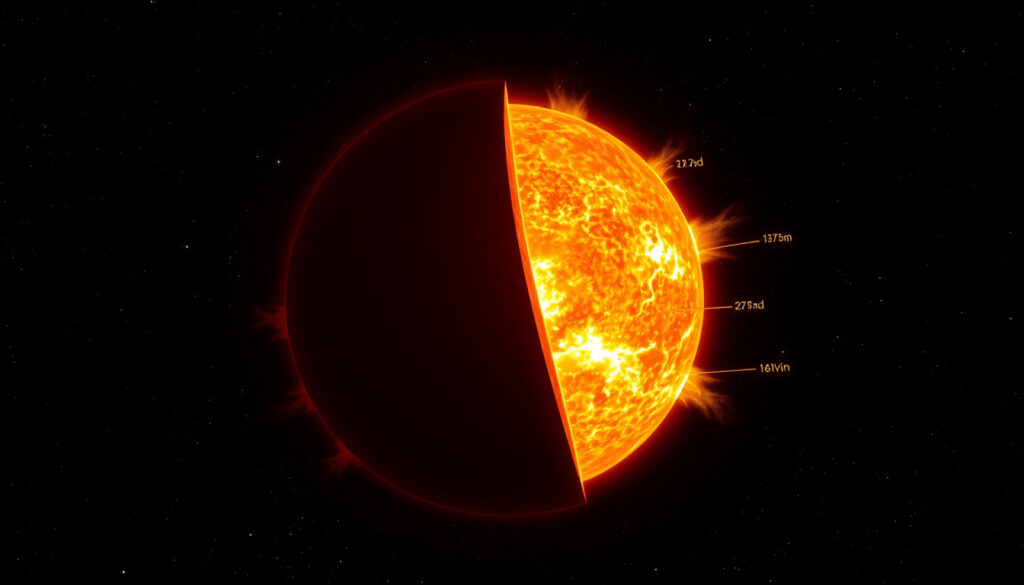
How Hot is the Sun? Core to Surface Temps in °C, °F, Kelvin
The Sun’s core blazes at 15 million °C, yet its visible surface sits at a comparatively cool 5,800 K — and the outermost corona reaches temperatures hot enough to defy everything we know about heat transfer. This guide breaks down every major layer of the Sun, from its blistering core to its mysteriously superheated outer atmosphere, with direct comparisons to familiar benchmarks like lava and Earth’s most extreme environments.
Core Temperature: 15 million °C (27 million °F) · Photosphere Temperature: 5,800 K (10,000 °F) · Corona Temperature: up to 5 million K · Sun’s Age Remaining: 5 billion years · Surface Viewed From Earth: appears 5,772 K
Quick snapshot
- Core reaches 15,000,000 °C where nuclear fusion occurs (Space.com)
- Visible surface (photosphere) averages 5,800 K (Las Cumbres Observatory)
- Exactly how the corona reaches millions of degrees hotter than the surface below it
- Sun has operated at stable temperatures for billions of years and will continue for roughly 5 billion more
- NASA’s Parker Solar Probe continues gathering direct measurements from inside the corona
| Layer | Temperature |
|---|---|
| Core | 15,000,000 °C |
| Photosphere | 5,772 K |
| Corona | 5,000,000 K |
| Luminosity | 3.828×10^26 W |
How many degrees hot is the Sun?
The Sun does not have a single temperature — it has several, depending on which layer you measure. Each zone of the solar interior and atmosphere operates at radically different conditions, and the numbers can seem counterintuitive.
Core temperature
At the Sun’s center, pressure and density reach levels that enable hydrogen atoms to fuse into helium. That reaction releases energy equivalent to roughly 3.828×10^26 watts continuously. The NOAA Space Weather Prediction Center (government solar research division) confirms the core temperature sits at approximately 15 million K — the same as 15 million °C within practical rounding, since the Kelvin and Celsius scales share the same degree size.
Photosphere temperature
The photosphere is the thin shell of gas that produces the visible light we see from Earth. According to Las Cumbres Observatory (global astronomical education network), this layer averages 5,800 K — roughly 10,000 °F. The Space.com (established science publication) notes it spans roughly 500 km, with temperatures dropping from around 6,125 °C at its bottom edge to about 4,125 °C at the top.
Corona temperature
The outermost atmosphere of the Sun — the corona — reaches temperatures of up to 2 million °C, and some measurements suggest peaks of 5 million °C or higher. The Space.com reports that scientists suspect tiny explosions called nanoflares may deliver bursts reaching 10 million °C locally, explaining the paradox of an outer layer far hotter than the surface below it.
How hot is the Sun core?
The core is where everything happens. Every photon of sunlight that reaches Earth traces its origin to nuclear fusion reactions compressed into this central sphere roughly 140,000 km in radius.
Measurement methods
Direct temperature readings of the core are impossible — no probe could survive the conditions. Instead, scientists infer core temperature through models calibrated by helioseismology (studying sound waves rippling through the Sun) and neutrino detection. The NOAA SWPC (official U.S. government solar science body) cites thermonuclear fusion as the energy source requiring this precise 15 million K threshold.
Comparison to surface
The core runs approximately 2,600 times hotter than the photosphere. That massive gradient drives the radiative zone above it, where energy slowly creeps outward over hundreds of thousands of years before reaching the convective zone and eventually the visible surface.
What is hotter, Sun or lava?
This comparison surfaces regularly because lava is Earth’s most dramatically hot substance most people will ever encounter. The short answer: every layer of the Sun far exceeds lava’s maximum temperature.
Lava temperatures
Volcanic lava on Earth ranges from about 700 °C to 1,200 °C depending on composition, with basaltic lava running hotter than rhyolitic types. The Astroquizzical (specialist astronomy education blog) points out that at its hottest, lava is only about half the temperature of the surface of the dimmest hydrogen-fusing stars — and our Sun is far more luminous than those faint red dwarfs.
The photosphere at 5,500 °C is roughly 4.5 times hotter than the hottest lava on Earth, and the corona at 2 million °C runs about 1,700 times hotter. Even red dwarf stars — the coolest true stars — stay above 3,000 °C at their surfaces.
Safe distances from lava
While comparing temperatures is one thing, survival distances are another. Touching lava causes immediate severe burns and can destroy tissue instantly, even before direct contact, due to radiant heat. The Orbital Today (space science publication) notes that lava maxes out at 1,200 °C, while every Sun layer exceeds that by orders of magnitude.
Is the Sun getting hotter?
Over the span of human civilization, the Sun’s output has remained remarkably stable — which is fortunate for life on Earth. Scientists continuously monitor solar irradiance for changes that could affect climate.
Changes over 30 years
Satellite measurements since the 1970s show the Sun’s total radiative output varies by only about 0.1–0.3% over typical solar cycles. NASA and other space agencies track these fluctuations closely, and no trend indicates the Sun is warming noticeably on human timescales.
Long-term evolution
On cosmic timescales, the Sun will gradually brighten. In roughly 1 billion years, solar luminosity may increase by about 10%, potentially rendering Earth inhospitable to complex life. Over the 5 billion years remaining in its main sequence phase, the Sun will eventually expand into a red giant — but that future is distant enough that current temperatures are essentially stable for civilization’s planning horizon.
What if Earth was 1 mile closer to the Sun?
The Sun-Earth distance averages about 93 million miles (150 million km). One mile more or less is such a vanishingly small fraction that it produces no measurable climate effect whatsoever.
Orbit changes impact
Earth’s orbit is elliptical, varying our distance from the Sun by millions of miles over a year. The difference between perihelion (closest approach, ~91.4 million miles) and aphelion (farthest, ~94.5 million miles) is roughly 3.1 million miles — orders of magnitude larger than a single mile shift. Seasons on Earth are driven primarily by axial tilt, not minor orbital variations.
For spacecraft navigating near Earth, orbital precision matters. For climate and habitability, what counts is the overall solar output and Earth’s atmospheric composition — not incremental distance changes.
Future Earth temperatures
NASA’s planetary science division ranks planetary temperatures based on solar distance, atmospheric composition, and greenhouse effects. Venus, closer to the Sun than Earth, runs far hotter than Mercury despite being farther away, because its dense CO₂ atmosphere traps heat. On Earth, human-caused greenhouse emissions already exert more influence on surface temperature than any plausible orbital nudge.
Three layers of the Sun operate at vastly different temperature scales, with the outermost atmosphere paradoxically the hottest of all.
| Object | Surface Temperature | Comparison |
|---|---|---|
| Sun core | 15,000,000 °C | Reference baseline |
| Sun corona | 1–5 million °C | ~100–300× photosphere |
| Sun photosphere | 5,500 °C | Reference surface |
| Red dwarf stars | ~3,000 °C | Still 2.5× hotter than lava |
| Sunspots | ~4,000 K | Cooler than average photosphere |
| Earth lava (max) | 1,200 °C | Only 1/4,600th of core |
Six measurable layers and features span a temperature range of nearly four orders of magnitude across the solar structure.
| Layer | Thickness | Temperature Range |
|---|---|---|
| Core | ~140,000 km radius | 15,000,000 °C |
| Radiative zone | ~300,000 km | 2–7 million °C |
| Convection zone | ~200,000 km | 2 million °C to 5,800 K |
| Photosphere | 500 km | 4,125–6,125 °C |
| Chromosphere | ~2,000 km | 6,000–20,000 °C |
| Corona | Extends millions of km | 1–5 million °C |
The Sun’s temperature profile runs counterintuitive to everyday experience: the farther you go from the core, the hotter the atmosphere becomes — a mystery scientists are still working to solve with missions like Parker Solar Probe.
Clarity on confirmed facts vs. open questions
Confirmed facts
- Core temperature at 15 million °C verified by multiple measurement approaches (NOAA SWPC, Space.com, Las Cumbres Observatory)
- Photosphere averages 5,800 K from spectroscopy consensus (UCAR, Las Cumbres Observatory)
- Corona reaches 1–2 million °C, visible during total eclipses (Space.com, Orbital Today)
- Lava maxes at 1,200 °C, far cooler than any solar layer (Astroquizzical)
Open questions
- Exact mechanism heating the corona above the photosphere — nanoflares remain hypothesis, not confirmed theory
- Whether Parker Solar Probe data will revise current temperature estimates for inner corona regions
“The photosphere is significantly cooler than temperatures at the sun’s core, which can reach about 27 million °F (15 million °C).”
— Space.com (established science publication)
“Surprisingly, the photosphere is also much cooler than the atmosphere above it, which has regions with temperatures as hot as 2 million °C.”
— UCAR Space Weather Education (university-level science education)
“At its hottest, lava is only half the temperature of the surface of the dimmest stars.”
For anyone relying on solar energy, climate planning, or simply life on this planet, the Sun’s temperature profile is not an abstract curiosity — it is the fundamental driver of nearly everything. The good news is that our star runs at remarkably stable temperatures, having sustained fusion for 4.6 billion years without significant fluctuation. The catch: as humanity grapples with long-term energy and climate strategy, understanding exactly how that heat engine operates becomes increasingly practical, not just scientifically interesting.
Related reading: NASA’s work on solar system threats · Cooking temperatures and oven tips
The Sun’s core reaches 15 million °C amid fusion chaos, while its surface glows at 5,800 K and corona spikes higher in core surface corona temperaturescore surface corona temperatures{/link> analysis.
Frequently asked questions
How hot is the sun in celsius?
The Sun’s core reaches approximately 15,000,000 °C. The visible surface (photosphere) averages about 5,500 °C, while the outer corona ranges from 1 to 5 million °C depending on measurement location.
How hot is the sun in fahrenheit?
Converting the core’s 15 million °C yields roughly 27 million °F. The photosphere at 5,500 °C translates to approximately 9,900 °F. NASA sources cite both scales for accessibility.
How hot is the Sun right now?
The Sun maintains consistent temperatures over human timescales. NASA satellite measurements show solar output varies only 0.1–0.3% between solar cycles, meaning the core, surface, and corona temperatures today match those of recent decades.
How hot is the Sun for kids?
Think of it this way: the hottest lava on Earth maxes out at around 1,200 °C. The Sun’s surface runs about 5,500 °C — roughly 4.5 times hotter than lava. The Sun’s core is 15 million °C, which is like 12,500 times hotter than lava. No material humans have ever created or any natural fire on Earth comes close.
How hot is the Sun in space?
In the near-vacuum of space between Earth and the Sun, temperature behaves differently than in an atmosphere. Without matter to transfer heat, a thermometer would read close to absolute zero in shadow. Near the Sun, radiation from the photosphere delivers heat equivalent to 5,800 K in direct sunlight.
How hot is the sun at night?
The Sun’s temperature does not change between day and night — it always burns at the same temperatures. Night on Earth simply means that particular location has rotated into shadow. The Sun itself remains at core temperatures regardless of which side of Earth is facing it.
Is Earth in danger in 2050?
Earth’s immediate danger comes from climate change driven by greenhouse gases, not solar variability. The Sun’s output is not projected to change significantly by 2050. What scientists watch for are solar storms that can disrupt power grids and satellites — a real but manageable risk.
How much age is left of sun?
The Sun is roughly 4.6 billion years old and has approximately 5 billion years remaining in its current main sequence phase before it expands into a red giant. This timeline is based on stellar evolution models supported by observations of similar stars at various life stages.
More related posts
 DVSA Theory Test BSL Accessibility: Guide & Options
 Harry Potter Birthday Cake: Canon Flavour, Recipe & Party Guide
 Ella Maisy Purvis: Biography, Career & Neurodiversity
 How to Get Rid of Ringworm – Effective Treatments and Tips
 When Is the Champions League Draw – 2025 Dates Times Confirmed
 Are Premium Bonds Worth It in 2026? Pros, Cons & Rates
 Thelo Aasgaard: Age, Dad, Transfer Fee, and Career Stats
 Cape Verdean Ethnicity, Identity, and Travel Guide
