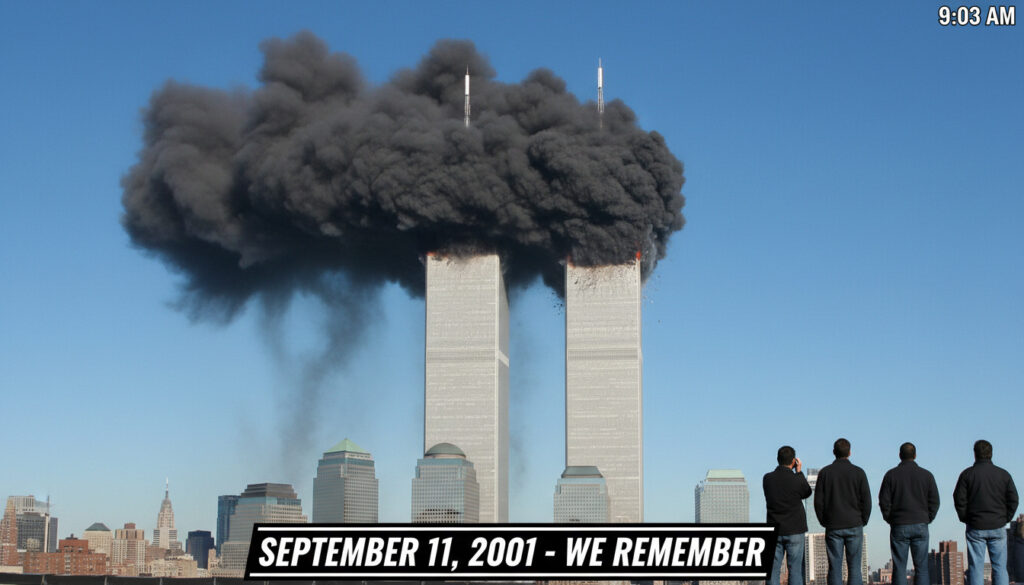
9/11 Attack – Timeline, Facts and Lasting Impact
On September 11, 2001, nineteen al-Qaeda terrorists hijacked four commercial airliners in a coordinated attack against the United States. Two planes struck the World Trade Center in New York City, one crashed into the Pentagon in Arlington, Virginia, and a fourth plummeted into a Pennsylvania field after passengers intervened, killing nearly three thousand people in the deadliest terrorist strike in modern history.
The assault unfolded over approximately two hours, destroying iconic structures and shaking global security frameworks. Beyond immediate casualties, the attacks triggered permanent changes in aviation security, foreign policy, and counterterrorism operations worldwide.
What Happened on 9/11?
The operation targeted symbolic American landmarks using fuel-laden aircraft as weapons. Nineteen hijackers seized control of four domestic flights departing from Boston, Washington Dulles, and Newark, intending to crash them into high-profile buildings.
- Coordinated Hijackings: Four simultaneous takeovers began between 8:14 and 8:42 a.m. EDT.
- WTC Destruction: Both Twin Towers collapsed within two hours of impact.
- Total Casualties: All 19 hijackers died alongside 2,977 victims.
- Airspace Closure: Operation Yellow Ribbon grounded all U.S. flights by 9:45 a.m.
- Structural Failure Sequence: The South Tower fell first at 9:59 a.m., despite being struck second.
- Passenger Resistance: Flight 93 crashed in Pennsylvania after passengers stormed the cockpit.
- Immediate Military Response: President Bush authorized shoot-downs and elevated defense readiness to DEFCON 3 following the final crash.
| Fact | Details |
|---|---|
| Date | September 11, 2001 |
| Time Duration | 8:14 a.m. – 10:28 a.m. EDT |
| Flights Hijacked | American Airlines 11, United Airlines 175, American Airlines 77, United Airlines 93 |
| Primary Targets | World Trade Center North Tower, World Trade Center South Tower, The Pentagon, U.S. Capitol (intended) |
| Hijacker Leader | Mohamed Atta |
| Death Toll | 2,977 victims (excluding hijackers) |
| South Tower Collapse | 9:59 a.m. (56 minutes after impact) |
| North Tower Collapse | 10:28 a.m. (102 minutes after impact) |
| Pentagon Impact | 9:37:46 a.m. |
| Flight 93 Crash | 10:03 a.m., Shanksville, PA |
Timeline of the 9/11 Attacks
The attacks followed a precise chronology beginning with hijacker movements in Maine and concluding with the collapse of the North Tower. Comprehensive timelines document every critical minute of the morning.
- : Mohamed Atta and Abdulaziz al-Omari pass security at Portland Jetport, Maine, connecting to Boston Logan for Flight 11.
- : American Airlines Flight 11 departs Logan Airport for Los Angeles, fourteen minutes behind schedule.
- : Hijackers seize Flight 11; flight attendant Betty Ann Ong contacts ground personnel to report the takeover.
- : Flight 11 impacts the North Tower between floors 93–99, killing all 92 aboard.
- : United Airlines Flight 175 strikes the South Tower between floors 77–85; all 65 occupants die instantly.
- : American Airlines Flight 77 crashes into the Pentagon’s western facade, killing 64 aboard and 125 on the ground.
- : The South Tower collapses fifty-six minutes after impact, per structural chronologies.
- : United Airlines Flight 93 crashes in Somerset County, Pennsylvania, after passengers revolt; all 44 aboard perish.
- : The North Tower collapses, concluding the building destruction phase.
Casualties and Immediate Impact
Death Toll Breakdown
The attacks claimed 2,977 lives excluding the hijackers. Flight 11 carried 92 fatalities, Flight 175 had 65, Flight 77 had 64, and Flight 93 had 44. The World Trade Center complex suffered approximately 2,600 deaths, while the Pentagon lost 125 personnel including emergency responders.
Health and Environmental Consequences
Thousands of survivors and first responders developed respiratory illnesses, cancers, and chronic conditions from toxic dust exposure at Ground Zero. Medical monitoring programs continue tracking these populations decades later.
The death toll continues rising as rescue workers and survivors succumb to 9/11-related illnesses caused by hazardous material exposure during recovery operations.
Who Was Responsible for 9/11?
The 19 Hijackers
Nineteen al-Qaeda operatives executed the plot, organized into four teams. Each aircraft carried a pilot-hijacker and supporting “muscle” hijackers armed with box cutters who subdued crew and passengers. Timeline documentation identifies Mohamed Atta (Flight 11), Marwan al-Shehhi (Flight 175), Hani Hanjour (Flight 77), and Ziad Jarrah (Flight 93) as the designated pilots.
Operatives utilized minimal weaponry—primarily knives and Mace—to breach cockpits, relying on surprise and the threat of explosives (later determined to be fake) to maintain control.
Osama bin Laden and al-Qaeda
Osama bin Laden, leading the Islamist extremist network al-Qaeda, orchestrated the attacks from Afghanistan. Historical records confirm he operated under Taliban protection, with the regime refusing extradition requests following earlier bombing incidents. Memorial archives document the organizational hierarchy connecting bin Laden’s leadership to field operatives.
Motives Behind the Attack
Bin Laden cited U.S. military presence in Saudi Arabia, support for Israel, and broader American foreign policy in the Middle East as primary grievances. The attackers framed the operation as jihad against Western influence in Islamic territories.
The plot emerged from Afghanistan’s safe haven under Taliban rule, where training camps operated without interference despite prior al-Qaeda attacks on U.S. targets.
Long-Term Impact of 9/11
Security and Policy Reforms
The attacks precipitated the creation of the Department of Homeland Security and the passage of the USA PATRIOT Act, expanding surveillance authorities and border security protocols. Presidential archives detail the immediate legislative response and military authorization.
Geopolitical Consequences
Military operations in Afghanistan began within weeks, targeting Taliban forces and al-Qaeda infrastructure. The conflicts expanded into broader counterterrorism campaigns that reshaped international alliances and domestic civil liberties debates.
Separating Verified Facts from Misinformation
| Established Information | Uncertain or Debunked Claims |
|---|---|
| Al-Qaeda planned and executed the attacks | Controlled demolition theories (refuted by structural analysis) |
| 19 hijackers participated; all died in crashes | Specific intended target of Flight 93 (White House or Capitol unconfirmed) |
| Fire-weakened steel caused tower collapses | Precise number of victims from subsequent related illnesses (ongoing tally) |
| Flight 93 passengers actively resisted hijackers | Additional unidentified co-conspirators within the United States (no evidence found) |
Historical Context and Background
The World Trade Center had previously been targeted in 1993 by Islamist terrorists intent on collapsing the North Tower. While that truck bombing failed to destroy the structure, it foreshadowed the persistent threat against American landmarks. Understanding the regional dynamics of Afghanistan during this period provides essential context; A Thousand Splendid Suns – Plot, Themes and Full Analysis explores the Taliban’s rule and societal conditions that enabled terrorist sanctuary. For a deeper dive into the events surrounding the attacks, The Summer I Turned Pretty Season 2.
Bin Laden’s declaration of war against the United States in 1998, followed by embassy bombings in East Africa and the USS Cole attack in Yemen, established clear precedents for the 2001 operation. Intelligence agencies documented these threats, though systemic failures prevented interception of the September 11 plot.
Official Sources and Documentation
The 9/11 Commission Report (2004) remains the authoritative government investigation, confirming al-Qaeda responsibility, detailed timelines, and intelligence community failures. Technical analyses by the National Institute of Standards and Technology (NIST) explain the structural collapses through fire-weakened steel and progressive failure mechanisms.
“No summation can capture the full dimensions of this tragedy or fully convey the horror experienced by victims and witnesses.”
— 9/11 Commission Report
Remembering September 11
The attacks of September 11, 2001, represent a pivotal moment in contemporary history, marking the transition into an era defined by enhanced security measures, global military engagement, and continuous counterterrorism vigilance. For detailed chronologies of the day, visit 9/11 Attack – Detailed Timeline, Hijackers and Facts.
Frequently Asked Questions
What does 9/11 stand for?
The term references the date September 11, 2001, when terrorists hijacked four planes and attacked U.S. landmarks, killing nearly 3,000 people.
How did the Twin Towers collapse?
Intense fires from jet fuel weakened steel support structures, causing progressive collapse. The South Tower fell after 56 minutes; the North Tower after 102 minutes.
Was anyone criminally prosecuted for the attacks?
No criminal trials occurred for the hijackers, as all died. Military commissions at Guantanamo Bay tried conspiracy defendants, including alleged mastermind Khalid Sheikh Mohammed.
How did 9/11 change airport security?
The Transportation Security Administration replaced private security, implementing reinforced cockpit doors, strict carry-on restrictions, and comprehensive passenger screening protocols.
What happened to the 9/11 hijackers?
All nineteen hijackers died in the four plane crashes. None survived to face prosecution or interrogation.
Where is the Flight 93 memorial located?
The crash site in Shanksville, Pennsylvania, hosts the Flight 93 National Memorial, honoring the 40 passengers and crew who died resisting hijackers.
More related posts
 Eve Myles: Ethnicity, Husband, Kids, Torchwood & Barrowman
 Molly Brown (Actress): Age, Husband, and Dexter: Original Sin
 Lacey Chabert: Hallmark Controversy, Biography, Family & FAQs
 Gail Porter: Illness, Sectioning, and Mental Health Advocacy
 Afternoon Tea in London – Best Venues, Prices and Guide 2025
 Steve Coogan Movies and TV Shows – Complete Filmography Guide
 Garden Centre Near Me: Dobbies Closures & October Planting
 Puerto Rico Gran Canaria: Guide, Beaches & Worth Visiting?
