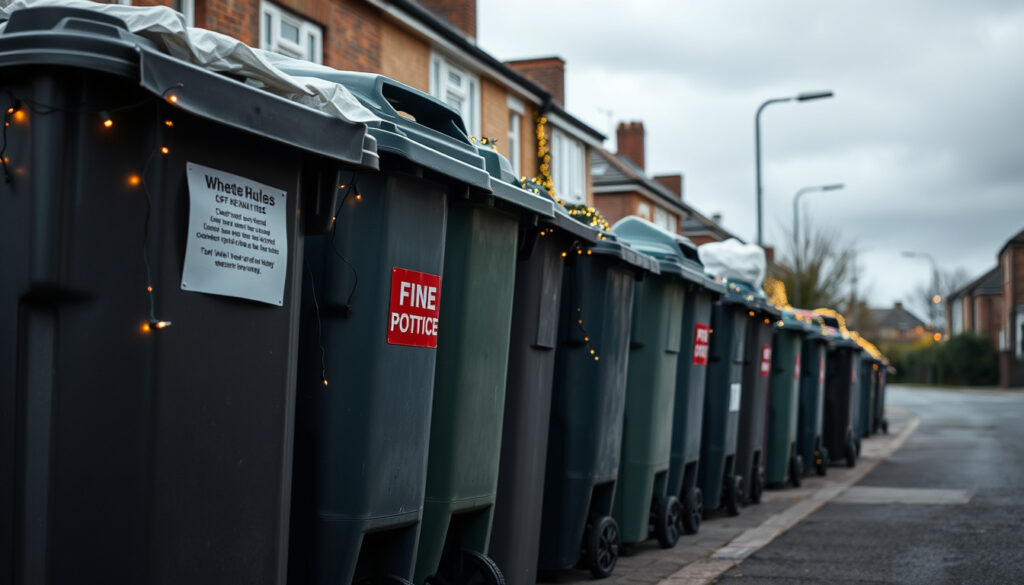
Holiday Wheelie Bin Fines UK: Key Rules and Penalties
If you’re heading off for a Christmas break and your wheelie bin stays out an extra day or two, you might assume it’s just untidy — not illegal. But councils across the UK have been cracking down harder, and some residents are coming home to fixed penalty notices for £80 or more. Here’s what the rules actually say, which mistakes cost the most, and how to leave your bins compliant when you’re away.
Common fine amount: £80 · Maximum reported fine: £400 · Authority for fines: UK councils · Holiday risk factor: Overflowing bins · Fixed penalty guidance: GOV.UK rules
Quick snapshot
- Fixed penalty maximum is £80 (GOV.UK official guidance)
- Community Protection Notices can reach £2,500 with criminal conviction (Wheelie Bins.co.uk enforcement report)
- Councils must issue written warning before any penalty (GOV.UK official guidance)
- Exact holiday fine amounts vary by council — no national register
- NHS-specific bin rules referenced in search appear not publicly documented
- How consistently councils enforce vs warn across regions
- June 2026: New bin collection framework begins under Better Recycling initiative
- April 2018: GOV.UK published current fixed penalty guidance
- December 2025: Christmas period with reported £400 fine cases
- 2026 changes may expand compulsory recycling to four-bins across more councils
- Enforcement likely to tighten as Better Recycling targets take effect
- More councils publishing holiday collection schedules online
These figures represent the tiered penalty system councils use when householders breach waste receptacle rules.
| Label | Value |
|---|---|
| Standard fine | £80 fixed penalty |
| High-end fine | £400 court case |
| Gov guidance date | 23 Apr 2018 |
| 2026 changes | June start |
| Holiday trigger | Overflowing bins |
| Notice response period | 28 days |
| CPN maximum | £2,500 |
| Penalty process start | Written warning |
Is it illegal to leave wheelie bins on the pavement in the UK?
The short answer is yes, in certain circumstances. It’s not the bins themselves that are illegal — it’s what they do. Under GOV.UK guidance, councils may issue fixed penalty notices when bins cause a nuisance or negatively affect public amenities (GOV.UK, guidance on household waste bins). That includes bins blocking wheelchair users onto the road, torn bags left on the pavement, or overturned containers left out for days.
Pavement parking rules for bins
The rule isn’t about the bin sitting on the pavement on collection day. It’s about obstruction. If your bin forces a pedestrian — particularly someone using a wheelchair or pushchair — to step into the road, the council has grounds to act. GOV.UK explicitly names this scenario as justifying a fixed penalty (GOV.UK, guidance on household waste bins).
What triggers a penalty and what doesn’t? GOV.UK is clear: councils cannot issue penalties for minor issues like putting waste in the wrong bin by mistake, forgetting to close the lid briefly, or leaving bins out a few hours before collection (GOV.UK, guidance on household waste bins). The distinction is between a genuine slip and a pattern that creates a hazard or eyesore.
Council enforcement examples
Stoke-on-Trent City Council has warned residents directly about Community Protection Notices for wheelie bin rule violations, with fines up to £2,500 and a potential criminal conviction (Wheelie Bins.co.uk). Tameside Council in Greater Manchester has issued similar warnings to residents (Wheelie Bins.co.uk). These notices stem from the Anti-Social Behaviour, Crime and Policing Act 2014, which introduced Community Protection Notices as a tool for councils to address persistent antisocial behaviour — including persistent bin misuse (Wheelie Bins.co.uk).
Can you be fined for not recycling in the UK?
In some areas, compulsory recycling is already in force. Islington Council has been among the most active in penalising households that fail to separate recyclables correctly. The principle is straightforward: if your council has a compulsory recycling scheme, putting the wrong materials in the wrong bin isn’t just a mistake — it’s a breach of the collection terms.
Compulsory recycling rules
Where these schemes exist, householders are required to separate materials at source. Contaminating a recycling bin with general waste, or vice versa, can trigger fixed penalties. GOV.UK guidance confirms councils may issue penalties when householders do not follow waste receptacle rules (GOV.UK, guidance on household waste bins). The key condition is that the non-compliance must cause a nuisance or negative effect on amenities — but councils operating compulsory schemes argue that contamination itself meets that threshold.
Islington Council examples
Islington has actively enforced recycling compliance, issuing warnings and fixed penalties to households that repeatedly fail to separate waste correctly. The council’s approach has drawn attention as a model other urban authorities are watching. The pattern is clear: first offence typically brings a warning; repeated contamination leads to financial penalties.
What this means: If your council has notified you of compulsory recycling requirements, read the terms carefully — the penalty process follows the same three-step structure as other bin fines: written warning, notice of intent, final notice with a 28-day response window (GOV.UK, guidance on household waste bins).
What are the new bin rules for 2026?
Major changes to UK bin collection frameworks are scheduled to begin in June 2026 under the Better Recycling initiative. The reform aims to standardise and improve recycling rates across England, with implications for how many bins households are expected to maintain and what can be placed in each.
Changes to bin collections
The 2026 changes are expected to expand the four-bins model — separating general waste, dry recyclables, food waste, and garden waste — to more councils. The rollout will bring new collection schedules and enforcement mechanisms. Councils will have greater powers to mandate compliance, and the fine structure for rule violations is likely to be clarified in line with updated GOV.UK guidance.
Better Recycling updates
Better Recycling targets set national performance indicators for local authorities. Councils that fail to meet recycling targets may face increased scrutiny and pressure to enforce existing rules more consistently. For householders, this means the tolerance for errors — such as placing the wrong item in the wrong bin — may decrease as councils are held more accountable for contamination rates.
The catch: the 2026 changes also bring opportunity. Households that adapt early and understand their council’s specific requirements will face lower risk of penalties during the transition period.
What happens if someone steals my wheelie bin?
A stolen wheelie bin is more than an inconvenience — it can leave you without the right receptacle for collection day, potentially leading to overflow or improper disposal. Here’s what to do and what your council owes you.
Reporting stolen bins
If your wheelie bin is stolen or removed without your consent, report it to your council immediately. Most councils consider bins as council property assigned to your address, and they have a responsibility to replace bins that are lost or stolen (Wheelie Bins.co.uk). Document the theft — take photos of the location, note the date — and provide your council’s reference number if you’ve reported it to police.
Replacement process
The replacement process varies by council. Most will provide a replacement bin free of charge or for a small admin fee if you can demonstrate the original was stolen or irreparably damaged. Some councils may charge for replacements if the bin was damaged through negligence or not stored securely. Contact your local authority’s waste team directly, or use their online portal if available.
Why this matters: Using an unassigned bin, borrowing a neighbour’s bin, or placing waste in bags because you lack a bin can each trigger complaints from neighbours or enforcement action from the council. Address the replacement quickly.
Is it illegal to put waste in someone else’s bin in the UK?
Putting waste — whether it’s a bag of rubbish or your dog’s poop — in someone else’s wheelie bin without their permission is not a minor indiscretion. In fact, it can constitute fly-tipping, which carries serious penalties.
Dog poop and neighbour rubbish rules
Dog faeces should go in your own general waste bin, sealed in a bag. Placing it in a neighbour’s bin without permission is technically deposing waste on someone else’s property without consent. While councils rarely pursue individual incidents of dog waste in the wrong bin, the principle extends to other types of household waste.
If a neighbour repeatedly puts their rubbish in your bin, you have grounds to complain to your council. The council can investigate and take action against the offender — particularly if it results in your bin overflowing or being flagged for contamination.
Fly-tipping penalties
Fly-tipping — depositing waste on land without permission — can result in fines of up to £400 on the spot, or significantly more if the case goes to court. The key legal distinction: fly-tipping involves waste deposited without the landowner’s permission. If someone puts waste in your bin without asking, that’s not fly-tipping by strict legal definition — but it could become a neighbour dispute or council enforcement matter depending on your council’s waste byelaws.
What to watch: Some councils have specific rules about who may use domestic bins. If you suspect someone is misusing your bin regularly, document the instances and report to your local authority’s environmental enforcement team.
How to avoid wheelie bin fines on holiday
Holiday periods are peak risk time for bin fines. When you’re away, bins left out overflow, lids stay open, and collections shift to different days. Here’s a step-by-step guide to staying compliant before you leave.
- Check your council’s holiday collection schedule — Most councils publish altered schedules around Christmas, New Year, and bank holidays. Lisburn and Castlereagh City Council, for example, shifts general waste collections from 25 December to 23 December, and pauses brown bin collections entirely from 22 December to 4 January (Lisburn Castlereagh Council). Worcester City Council, by contrast, makes no changes to domestic collections for Spring Bank Holiday since there is no Monday service (Worcester City Council). Know your council’s specific dates before you travel.
- Bring bins back promptly after collection — Don’t leave bins out overnight or for days after collection day. Worcester City Council specifies bins should be out by 7am on collection day (Worcester City Council). Leaving bins out overnight risks not just fines but also theft, fire, or giving burglars an access cue (Wheelie Bins.co.uk).
- Don’t overfill — An overflowing bin with the lid open can attract enforcement attention. If you’re going away and have extra waste buildup, look into whether your council offers additional collections or drop-off services. Cardiff allows residents to book collections for overflowing wheelie bins (Dumpawaste).
- Close lids securely — Tandridge District Council specifically advises closing the lid on brown bins during the festive period (Tandridge District Council). An open lid is an easy trigger for a warning.
- Know what goes where — During the holidays, specific items need specific handling. Broken glass baubles go in the general rubbish bin, not recycling (Tandridge District Council). Christmas lights can be recycled in a supermarket carrier bag next to your food caddy by 6am (Tandridge District Council). Batteries should be in a sealable bag next to your food waste caddy or taken to shops and community recycling centres (Tandridge District Council).
- Arrange a neighbour check-in if possible — If you’re away for more than a week, ask a trusted neighbour to bring your bins back in after collection and watch for overflow. This is the single most effective holiday precaution available.
The UK Government explicitly states it wishes to encourage a measured approach where householders are not penalised for minor breaches of waste bin rules (GOV.UK guidance). But councils are under increasing pressure to meet recycling targets, and holiday periods create enforcement opportunities they can’t ignore. The residents least likely to be fined are those who know their council’s specific schedule, keep bins properly managed, and sort waste correctly.
Stoke-on-Trent and Tameside councils have both warned residents about Community Protection Notices, which can reach £2,500 and leave a criminal record (Wheelie Bins.co.uk). These escalation cases — typically triggered by repeated violations or obstruction — show how councils are applying the Anti-Social Behaviour, Crime and Policing Act 2014 to persistent bin misuse.
Related reading: What Is My Postcode? Find It Fast with Official Tools · How Many Counties in England? Resolving 48 vs 27 Confusion
lisburncastlereagh.gov.uk, tandridge.gov.uk, capitallettersigns.co.uk, worcester.gov.uk
Holiday wheelie bin fines underscore the need to track changes like Englands 2026 bin rules, which will standardize collections and recycling across England from March 2026.
Frequently asked questions
Do councils fine for bins left out on holiday?
Yes, but usually after a warning. If your bin obstructs a pavement or looks unsightly for days while you’re away, a neighbour or council inspector may flag it. Repeated issues or documented obstruction can trigger a fixed penalty notice. The risk is highest during holiday periods when bins are left out longer and collections shift.
What items are banned from UK bins?
Specific restrictions vary by council, but common bans include electrical items (WEEE), hazardous waste like paint or chemicals, construction waste, and medical waste. Batteries must go in designated collection points. During the festive period, councils like Tandridge specify that broken glass baubles belong in general waste, not recycling (Tandridge District Council).
Is pavement parking for cars linked to bin fines?
Not directly. Pavement parking for vehicles is a separate issue regulated under different rules. However, if your wheelie bin obstructs a pavement in a way that forces pedestrians into the road, it can trigger the same enforcement mechanism as a vehicle obstruction. The council’s powers under GOV.UK guidance apply to bins, not cars.
How to report neighbour bin misuse?
Contact your local authority’s environmental enforcement team. Most councils have an online reporting form or a dedicated phone line. Document the misuse — take dated photos, note times, and keep records of repeated incidents. The council will investigate and determine whether enforcement action is warranted.
What if donkeys damage bins in New Forest?
Livestock damage to bins is an unusual but real issue in some rural areas. If animals damage your bin, report it to your council and explain the circumstances. Most councils will replace bins damaged by external factors beyond your control without charge. Keep records and photos of the damage.
Are there fines for clothes in wrong bank?
Clothes banks are for textiles only. Placing clothes in glass banks, paper banks, or general waste bins when they should go to a textile bank is a contamination issue. Some councils issue warnings for first offences; others may issue fixed penalties where compulsory recycling schemes are in force. Check your council’s specific textile recycling requirements.
Who pays for stolen wheelie bin replacement?
In most cases, the council. Wheelie bins are typically council property assigned to your address. Report the theft to your council as soon as possible and request a replacement. You may need to provide a police reference if you reported the theft to police first.
Can councils take bins away as a penalty?
Councils generally do not remove bins as a penalty for first or minor offences. However, persistent non-compliance — such as repeatedly placing banned items in bins or refusing to separate recyclables — could theoretically result in a formal warning leading to service withdrawal. This is rare and would follow extensive correspondence and a formal process.
“The Government wishes to encourage a measured and balanced approach, where householders are not penalised for minor breaches of waste bin rules.”
— UK Government guidance on household waste bins (GOV.UK)
“Increasing numbers of residents are being warned that they could face a £2,500 fine and a criminal conviction if they overfill their bins.”
— Wheelie Bins.co.uk
The enforcement landscape for wheelie bin fines in the UK sits at an interesting juncture. Official guidance is clear that councils should not penalise minor breaches, but councils like Stoke-on-Trent and Tameside are actively publicising the £2,500 Community Protection Notice route for serious or persistent violations. The 2026 Better Recycling changes will likely sharpen this distinction — councils with ambitious recycling targets will have strong incentives to enforce compulsory sorting strictly, and residents in those areas will face higher scrutiny. For anyone planning a holiday, the practical steps are straightforward: check your council’s altered schedule, don’t overfill, close the lid, and bring bins back in quickly after collection. Do that and the fine risk drops to near zero.
More related posts
 Liza Goddard Now: Biography, Family, and Current Life
 Molly Brown (Actress): Age, Husband, and Dexter: Original Sin
 How Hot is the Sun? Core to Surface Temps in °C, °F, Kelvin
 Ty Mawr Holiday Park – Towyn Family Guide and Reviews
 Martin Sheen Movies and TV Shows – Complete Filmography Guide
 Robin Windsor: Strictly Come Dancing star’s death and inquest
 How to Get Rid of Ringworm – Effective Treatments and Tips
