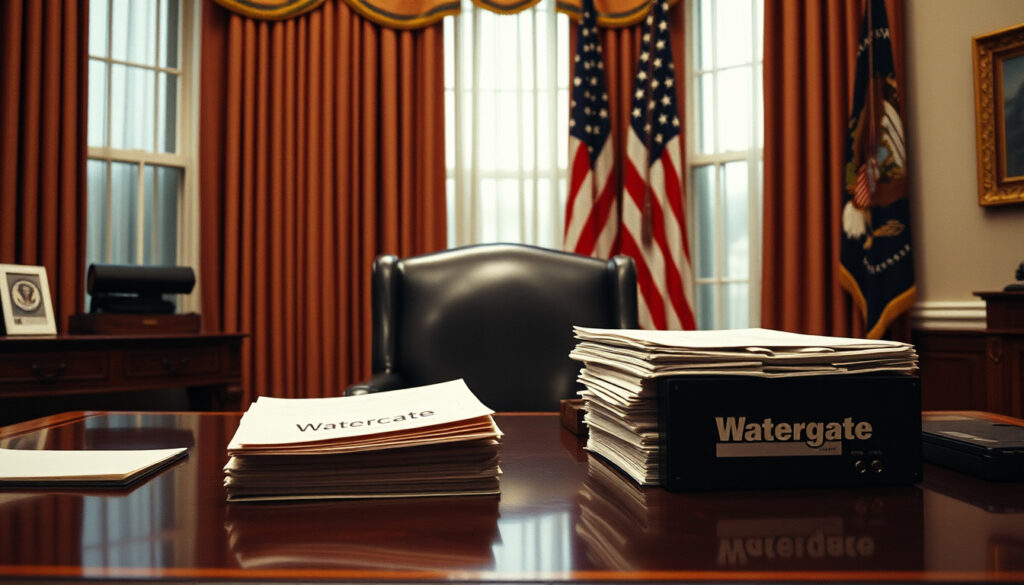
Richard Nixon: Watergate Scandal and Resignation
Few American presidencies pack as much drama, paradox, and lasting consequence as Richard Nixon’s. He opened relations with China, created the EPA, and then became the only U.S. president to resign. This article separates the foreign-policy triumphs from the Watergate scandal and the personal tragedy of his final years, building a fact-checked chronology with official and editorial sources.
Born: January 9, 1913 · Died: April 22, 1994 · Presidency: 1969–1974 · Resignation: August 8, 1974
Quick snapshot
- Born January 9, 1913 in Yorba Linda, California (Miller Center presidential biography)
- Attended Whittier College and Duke University Law School (Miller Center presidential biography)
- Served in the U.S. Navy during World War II (Miller Center presidential biography)
- 37th president (1969–1974) (Association for Diplomatic Studies and Training foreign policy archive)
- Signed Environmental Protection Agency and OSHA into law (Association for Diplomatic Studies and Training foreign policy archive)
- Opened diplomatic relations with China and pursued détente with USSR (Association for Diplomatic Studies and Training foreign policy archive)
- Break-in at DNC headquarters on June 17, 1972 (Britannica encyclopedic reference)
- Nixon’s involvement in cover-up (Britannica encyclopedic reference)
- House Judiciary Committee approved articles of impeachment (Britannica encyclopedic reference)
- Resigned on August 8, 1974 (Britannica encyclopedic reference)
- Retired to California and later New Jersey, wrote memoirs (Miller Center presidential biography)
- Suffered a stroke on April 18, 1994 and died on April 22, 1994 (Miller Center presidential biography)
- Buried at Nixon Library in Yorba Linda, California (Miller Center presidential biography)
Seven key facts, one pattern: a life of rapid ascent, landmark policy, and a scandal that rewrote the rules of presidential accountability.
| Fact | Detail |
|---|---|
| Full Name | Richard Milhous Nixon |
| Born | January 9, 1913, Yorba Linda, California |
| Died | April 22, 1994, New York City |
| Presidency | 1969–1974 |
| Political Party | Republican |
| Vice President | Spiro Agnew (1969–1973), Gerald Ford (1973–1974) |
| Notable Events | Watergate scandal, resignation, opening of China |
What was Richard Nixon accused of doing?
The core accusation was that Nixon and his aides orchestrated a burglary and wiretapping operation at the Democratic National Committee headquarters in the Watergate complex, then spent months covering it up. The break-in occurred on June 17, 1972, carried out by operatives tied to Nixon’s re-election campaign (Britannica encyclopedic reference). Investigative reporting by Bob Woodward and Carl Bernstein of The Washington Post helped expose the cover-up (EBSCO Research Starters academic resource).
Who was blamed for Watergate?
- Blame fell on Nixon himself after tapes revealed he had approved a plan to use the CIA to block the FBI’s investigation. On August 5, 1974, Nixon released transcripts of a June 23, 1972 conversation that showed his direct involvement – the “smoking gun” (Britannica encyclopedic reference).
- Several aides were convicted, including White House counsel John Dean and Attorney General John Mitchell.
- The House Judiciary Committee voted three articles of impeachment against Nixon: obstruction of justice, abuse of power, and contempt of Congress.
Nixon’s own tape recordings – his secret system for preserving his legacy – became the evidence that forced him from office. The paradox: the same president who used technology to control his image was undone by it.
Did Nixon ever apologize for Watergate?
In his resignation speech on August 8, 1974, Nixon expressed regret for any “wrong judgments” but did not offer a direct apology. According to family accounts, his last words reportedly included “I’m sorry” (Miller Center presidential biography). No public, full apology was ever issued. Some close associates later claimed he expressed private remorse, but the historical record lacks a clear, on-the-record apology.
Which president cried and quit?
The phrase “cried and quit” describes Richard Nixon, who became the first and only U.S. president to resign. On the evening of August 8, 1974, he addressed the nation from the Oval Office and announced his resignation, effective at noon the next day (Association for Diplomatic Studies and Training foreign policy archive).
Why did Richard Nixon resign?
- He faced near-certain impeachment in the House and conviction in the Senate after the “smoking gun” tape was released (Britannica encyclopedic reference).
- The resignation letter was addressed to Secretary of State Henry Kissinger, who initialed it at 11:35 a.m. on August 9 (Archives Foundation primary document repository).
- An emotional farewell to White House staff the next morning became one of the most replayed moments in political television.
The resignation set a constitutional precedent: no president is above the law. For the American public, it shattered trust in the executive branch, and for politicians, it created a permanent caution about secret tapes and unchecked power.
What is Richard Nixon famous for?
Nixon is famous for the Watergate scandal and his resignation, but also for significant foreign policy and domestic achievements that defined his presidency.
What did Richard Nixon do as president?
- Foreign policy: He opened diplomatic relations with China in 1972 and pursued détente with the Soviet Union, signing the SALT I arms control treaty (Association for Diplomatic Studies and Training foreign policy archive).
- Domestic policy: He signed the Environmental Protection Agency (EPA) and the Occupational Safety and Health Act (OSHA) into law, and issued an executive order implementing Title IX, which banned sex discrimination in education (Britannica encyclopedic reference).
- He successfully de-escalated the Vietnam War through a policy of Vietnamization and withdrew U.S. ground troops.
What was Richard Nixon’s role in World War II?
Nixon served in the U.S. Navy during World War II, rising to the rank of lieutenant commander. He worked in the Pacific theater as a logistics officer and did not see combat, but his service helped him win a congressional seat in 1946.
The pattern: Nixon’s foreign policy achievements – which he considered his true legacy – were so substantial that even his funeral eulogy by President Bill Clinton focused on them rather than the scandal (Miller Center presidential biography).
What was the cause of death for Richard Nixon?
Richard Nixon died on April 22, 1994, from complications of a stroke. He had suffered a stroke on April 18, 1994, while at his home in Park Ridge, New Jersey (Miller Center presidential biography). He was 81 years old. His funeral drew every living U.S. president and dignitaries from around the globe (Miller Center presidential biography).
What were Richard Nixon’s last words?
Accounts differ on Nixon’s exact last words. Family members and aides have said he whispered “I’m sorry” or “I’m truly sorry” in his final moments (Miller Center presidential biography). The wording is disputed – some sources claim he said “I’m sorry” about his family, others that it was a general apology. No definitive recording exists.
The trade-off: without an official record, the story of Nixon’s last words remains a humanizing anecdote, but it cannot be confirmed as historical fact. It adds to the unresolved narrative around his remorse.
Timeline: Richard Nixon’s life and resignation
- January 9, 1913 – Richard Nixon born in Yorba Linda, California
- 1946 – Elected to U.S. House of Representatives
- 1952 – Elected Vice President under Dwight D. Eisenhower
- 1960 – Lost presidential election to John F. Kennedy
- 1968 – Elected 37th President of the United States
- June 17, 1972 – Watergate break-in (Britannica encyclopedic reference)
- 1973–1974 – Senate Watergate hearings and investigations
- August 8, 1974 – Resignation speech; resigned the presidency (Association for Diplomatic Studies and Training foreign policy archive)
- April 22, 1994 – Died after suffering a stroke (Miller Center presidential biography)
Confirmed facts vs. unclear accounts
Confirmed facts
- Nixon resigned on August 8, 1974, effective August 9 at noon (National Archives blog official government record)
- The Watergate break-in occurred on June 17, 1972
- Nixon was pardoned by President Ford on September 8, 1974 (Miller Center presidential biography)
- Cause of death was complications from a stroke
What’s unclear
- Exact wording of Nixon’s last words (disputed accounts)
- Whether Nixon ever fully apologized for his role in Watergate – some claim private expressions, but no public apology was given
Quotes from Nixon and his circle
I am not a crook. I have earned everything I have got. – Richard Nixon, press conference on November 17, 1973
Therefore, I shall resign the Presidency effective at noon tomorrow. – Richard Nixon, resignation speech, August 8, 1974
He was a great man of vision, but also a man of deep flaws. – Family account, reflecting on his last words “I’m sorry”
Summary
Richard Nixon’s legacy is a paradox: the architect of historic foreign policy breakthroughs and the only U.S. president forced to resign. For the American public, the lesson is that no leader is above accountability. For historians, the gap between his achievements and his disgrace remains one of the most debated chapters in American political history. For readers searching for closure on the Watergate era, the evidence is clear: Nixon resigned because the tapes proved he directed a cover-up, and he never publicly apologized for it.
For the political elite, the choice is straightforward: embrace the foreign policy legacy or confront the domestic scandal. For the average citizen, the story is a reminder that power unchecked by transparency eventually becomes its own undoing.
Frequently asked questions
What was the outcome of the Watergate investigation?
The investigation led to Nixon’s resignation, convictions of several White House aides, and reforms in campaign finance and government ethics.
What did Richard Nixon do after resigning?
He retired to San Clemente, California, later moved to New Jersey, wrote several memoirs, and remained an unofficial adviser on foreign policy (Miller Center presidential biography).
Who succeeded Richard Nixon as president?
Gerald Ford, his vice president, became the 38th president upon Nixon’s resignation (Britannica encyclopedic reference).
How did the Watergate scandal affect public trust?
It caused a sharp decline in trust in government, which persisted for decades and influenced media coverage of subsequent presidencies.
What is the Richard Nixon Presidential Library and Museum?
It is a presidential library in Yorba Linda, California, operated by the National Archives, housing Nixon’s papers and artifacts.
Did Nixon have any role in foreign policy after his resignation?
Yes, he acted as an informal adviser to later presidents and published books on foreign policy, including Beyond Peace (Miller Center presidential biography).
Related reading: White House Down cast · Matt Hancock scandal timeline
More related posts
 Is Swimming Good for Weight Loss? Benefits & Realistic Tips
 Mackenzie Crook: Biography, Sister, Illness, and Detectorist
 Argo Blockchain Share Price: Why It’s Low and Outlook
 Holiday Wheelie Bin Fines UK: Key Rules and Penalties
 James Dreyfus: What Happened, Career, and Controversies
 Steve Coogan Movies and TV Shows – Complete Filmography Guide
 Josh Widdicombe: Wife, Kids, Pectus Excavatum & Sobriety
 Are Trains Running Today – Live Status Check Guide
