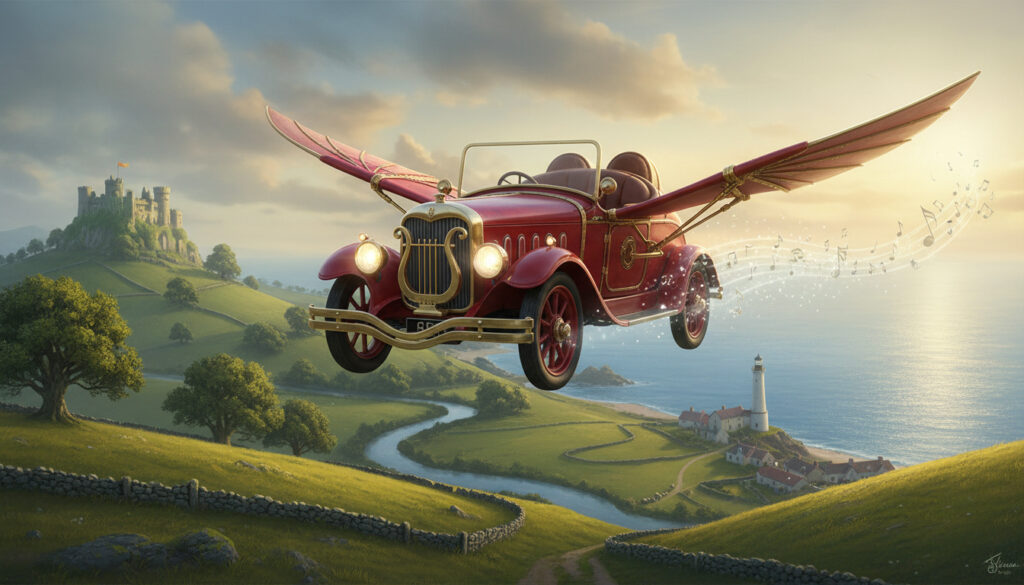
Chitty Chitty Bang Bang – Cast, Plot, Songs and Legacy
Chitty Chitty Bang Bang stands as one of cinema’s most enduring family musicals. Released in 1968, this fantasy adventure pairs whimsical invention with memorable melodies, anchored by Dick Van Dyke’s performance as eccentric inventor Caractacus Potts.
The film emerged from an unexpected creative partnership. James Bond author Ian Fleming wrote the original 1964 children’s novel for his son, while producer Albert R. Broccoli—fresh from 007 successes—shepherded the big-screen adaptation. Director Ken Hughes collaborated with legendary children’s author Roald Dahl on the screenplay, blending live-action with animated sequences.
More than five decades later, the story of a magical flying car continues to captivate audiences through theatrical re-releases, stage productions, and cultural references that cement its status as a holiday-season staple.
What is Chitty Chitty Bang Bang?
- Fleming’s sole children’s book: The James Bond creator wrote only this one novel for young readers.
- Record-breaking prop: The car model required unprecedented engineering for 1960s special effects.
- Continuous stage presence: The 2002 West End adaptation continues to tour globally.
- Box office leader: Became the top-grossing US film of 1969.
- Award recognition: Earned Academy Award and Golden Globe nominations for the title song.
- Literary crossover: Roald Dahl co-wrote the screenplay, adding darker fantasy elements.
- Producer pedigree: Albert R. Broccoli transferred his Bond production expertise to family entertainment.
| Fact | Details |
|---|---|
| Lead Actor | Dick Van Dyke |
| Lead Actress | Sally Ann Howes |
| Director | Ken Hughes |
| Producer | Albert R. Broccoli |
| Screenplay | Ken Hughes and Roald Dahl |
| Source Material | Ian Fleming novel (1964) |
| UK Release | December 17, 1968 |
| US Release | December 18, 1968 |
| Music | Sherman Brothers |
| Budget | $11 million |
| Box Office | $29 million+ (adjusted) |
| Awards | Golden Globe nominations (Best Original Song, Best Original Score) |
Who Stars in Chitty Chitty Bang Bang?
Lead Performers
Dick Van Dyke headlines as Caractacus Potts, the eccentric inventor who restores a wrecked racecar into the magical vehicle. Sally Ann Howes portrays Truly Scrumptious, the daughter of a wealthy candy factory owner who joins Potts and his children on their adventures.
Supporting Cast
Lionel Jeffries appears as Grandpa Potts, while Gert Fröbe—known for his role as Goldfinger—plays the villainous Baron Bomburst. Anna Quayle portrays the Baroness, and Benny Hill takes a rare dramatic turn as the Toymaker. Robert Helpmann’s portrayal of the Child Catcher remains particularly memorable in cinematic history.
Production Locations
Primary filming occurred entirely within England. Pinewood Studios hosted interior sequences and elaborate sets including the Vulgaria castle. Exterior shots utilized rural English countryside, coastal beaches, and specific seaside locations.
The film’s blend of live-action and animation required complex technical coordination. Marc Breaux and Dee Dee Wood staged the musical numbers, while Irwin Kostal supervised the orchestral arrangements.
What Is the Plot and Are the Songs in Chitty Chitty Bang Bang?
Story Overview
Set in 1910s rural England, the narrative follows inventor Caractacus Potts as he restores a derelict racing car that exhibits magical abilities including flight and amphibious travel. Following a beach picnic where Potts improvises a story for his children Jemima and Jeremy, the family finds themselves drawn into the fictional tale of Baron Bomburst of Vulgaria.
The tyrannical Baron covets the magical car while enforcing a ban on children in his kingdom. The family travels to Vulgaria, evades the sinister Child Catcher, rescues imprisoned children, and ultimately helps overthrow the Baron with assistance from a toymaker and local villagers before flying home.
Musical Numbers
Richard and Robert Sherman composed the score, creating melodies that earned the title track nominations for both an Academy Award and a Golden Globe for Best Original Song. The soundtrack also received a Golden Globe nomination for Best Original Score.
Literary Origins
The screenplay significantly expands Fleming’s 1964 novel. While the book focuses on family adventures with the car, Dahl and Hughes added the musical framework, heightened fantasy elements, and the entire Vulgaria sequence. The novel itself drew loose inspiration from a 1920s racing car owned by Fleming’s neighbor, Count Louis Zborowski.
What Is the Legacy of Chitty Chitty Bang Bang?
Stage Adaptations
A stage musical premiered in London’s West End in 2002, featuring a book by Hugh and Roger Loomis alongside the Sherman Brothers’ original music with additional songs. The production ran until 2005 before transferring to Broadway the same year. Global tours continue, utilizing a large mechanical puppet to represent the flying car.
The Real Car
The fictional vehicle traces its lineage to a genuine 1920s racing car nicknamed “Chitty Bang Bang” for its distinctive engine sound, owned by Count Louis Zborowski. Multiple replicas of the cinematic magical car have since been constructed for promotional tours and museum exhibitions.
Count Louis Zborowski’s original vehicles competed in early Grand Prix racing. The film’s car replicas now serve as centerpiece exhibits at various automotive museums, though no single “original” film prop remains intact in public display.
Streaming availability varies by region and licensing agreements. The film has previously appeared on platforms carrying MGM/United Artists catalogs, including releases through MGM Home Entertainment and CBS/Fox. Current subscribers should verify access through their specific providers.
How Did Chitty Chitty Bang Bang Evolve Over Time?
- : Ian Fleming publishes the children’s novel Chitty-Chitty-Bang-Bang, the Magical Car.
- : The film premieres in the United Kingdom.
- : The United States release follows, eventually becoming the top-grossing film of 1969.
- : The stage musical adaptation opens in London’s West End.
- : The production transfers to Broadway.
- : Global touring productions continue, alongside museum exhibitions of car replicas.
What Facts Are Certain About Chitty Chitty Bang Bang?
Established Information
- The film is fictional, loosely inspired by Count Zborowski’s real racing car.
- Ken Hughes directed and co-wrote the screenplay.
- The Sherman Brothers composed all musical numbers.
- The 1968 release marked Dick Van Dyke’s follow-up to Mary Poppins.
- The stage musical premiered in 2002.
Information Remaining Unclear
- Exact current location of all original film props and miniatures.
- Specific future remake or reboot production schedules.
- Precise streaming availability by region, as licensing rotates periodically.
- Complete technical specifications of all replica cars built for exhibitions.
Why Does Chitty Chitty Bang Bang Remain Culturally Significant?
The film occupies a unique position between Victorian adventure stories and 1960s psychedelic fantasy. Its visual aesthetic—combining Edwardian costumes with fantastical mechanical inventions—created a timeless quality that avoids dating itself to a specific decade.
Unlike many family films of its era, Chitty Chitty Bang Bang incorporates genuinely menacing elements through the Child Catcher and the Vulgaria sequences, creating narrative tension that respects children’s capacity for complex emotions. This balance of whimsy and danger reflects Roald Dahl’s screenplay influence.
The production also represents a transitional moment in cinematic technology, bridging practical effects with early mechanical automation. The car’s flying sequences required innovative rigging and photography techniques that influenced subsequent fantasy filmmaking.
What Do Primary Sources Reveal?
“Fleming wrote the original novel specifically for his son, creating a rare departure from his James Bond thrillers.”
— Wikipedia, citing Fleming family archives
“Roald Dahl expanded the screenplay significantly beyond the book’s scope, adding the musical elements and Vulgaria sequences that define the film’s narrative structure.”
— Rotten Tomatoes, film analysis
“The stage adaptation utilizes a large puppet mechanism to represent Chitty, requiring specialized technical crews for each touring production.”
— Mubi, production notes
What Defines Chitty Chitty Bang Bang’s Enduring Appeal?
Chitty Chitty Bang Bang persists as a multigenerational touchstone through its synthesis of inventive storytelling, memorable music, and technical ambition. The transformation of a wrecked racecar into a magical vehicle symbolizes the film’s broader themes of imagination overcoming material limitations, while the continued stage productions and museum exhibitions ensure new audiences discover the adventure decades after its initial release.
Frequently Asked Questions
Is Chitty Chitty Bang Bang based on a true story?
No. While the story draws loose inspiration from Count Louis Zborowski’s real 1920s racing car nicknamed “Chitty Bang Bang,” the plot, characters, and magical elements are entirely fictional creations of Ian Fleming and the screenwriters.
Who wrote the original Chitty Chitty Bang Bang book?
Ian Fleming, creator of James Bond, wrote the 1964 children’s novel Chitty-Chitty-Bang-Bang, the Magical Car for his son. It remains Fleming’s only published children’s book.
What happened to the original Chitty Chitty Bang Bang car?
Multiple replicas were built for filming and promotions. No single “original” car remains in definitive public display, though various models appear in museums and exhibitions worldwide.
Where was Chitty Chitty Bang Bang filmed?
Entirely in England, primarily at Pinewood Studios for interior sets including Vulgaria castle, with exterior shots in rural English countryside and coastal locations.
Is there a stage version of Chitty Chitty Bang Bang?
Yes. A musical adaptation premiered in London’s West End in 2002, moved to Broadway in 2005, and continues to tour globally with a large mechanical puppet representing the car.
Who plays the Child Catcher?
Robert Helpmann portrayed the Child Catcher in the 1968 film. The character remains one of cinema’s most memorable villains despite limited screen time.
Did Chitty Chitty Bang Bang win any Oscars?
The film received an Academy Award nomination for Best Original Song for the title track but did not win. It also earned Golden Globe nominations for the song and score.
More related posts
 iPhone 12 Screen Size – Dimensions and Specs for All Models
 How Many Teaspoons in a Tablespoon – US, UK and Global Standards
 Eurostar London to Paris: Times, Tickets and Guide
 Party Food to Order: Catering Tips, Costs & Popular Picks
 Minka Kelly Movies and TV Shows: Full Filmography List
 Yours Faithfully or Sincerely: Rules for Formal Letters
 How to Print Screen on Windows 10 & 11: Keyboard Shortcuts
 PGLUCKY88.PRO Slot: Verified Data, Traffic & User Questions
