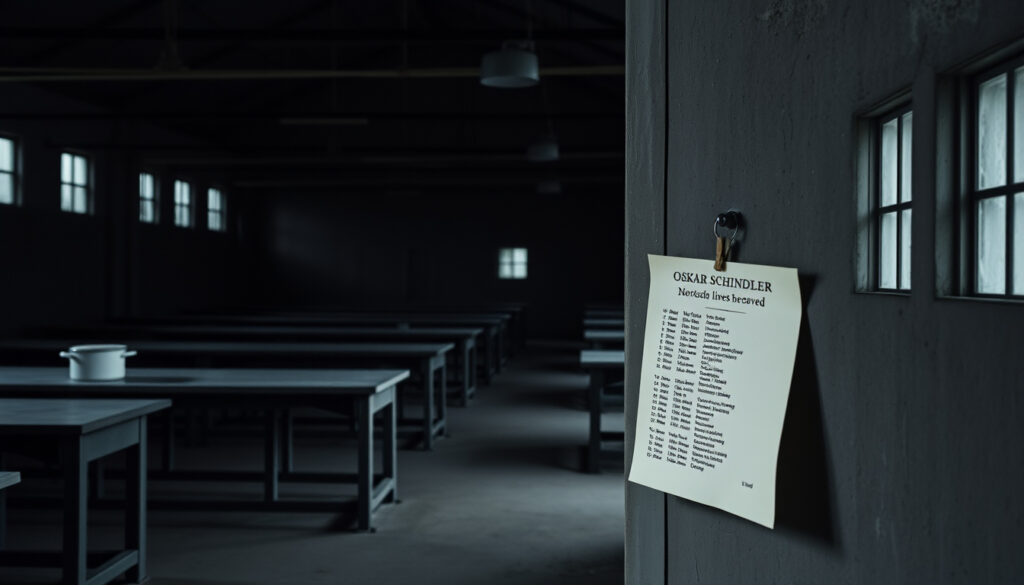
Oskar Schindler: Was He a Good Man? Biography & Legacy
Few Holocaust stories spark as much moral confusion as Oskar Schindler’s. A Nazi Party member who drank heavily, cheated on his wife, and ran factories on slave labor — yet also spent his entire fortune bribing officials to save 1,200 Jewish lives. This article separates the man from the myth, weighing his heroic rescue against his personal failures.
Jews saved by Oskar Schindler: 1,200 ·
Years of life: 1908–1974 ·
Recognized as Righteous Among the Nations: 1963 ·
Estimated descendants of Schindler Jews alive today: Over 4,000 ·
Failed business ventures after WWII: Multiple
Quick snapshot
- Saved about 1,200 Jews by employing them in his factories (Britannica)
- Joined the Nazi Party in 1939 (U.S. Holocaust Memorial Museum)
- Spent his fortune on bribes to protect workers (Facing History & Ourselves)
- Honored as Righteous Among the Nations in 1963 (Yad Vashem)
- Exact number of Jews saved – estimates range from 1,100 to 1,200 (Britannica)
- Primary motivation – altruism versus profit or personal connections (USHMM)
- Full extent of his unfaithfulness and its impact on his marriage (Forbes)
- Whether he would have acted differently if not facing the end of the war (Facing History)
- 1944: Refuses to ship workers to Auschwitz; compiles list of 1,100+ names (Facing History)
- 1945: Flees with wife to avoid Soviet capture (Britannica)
- 1974: Dies in poverty at age 66 (Britannica)
- Survivors and descendants continue Holocaust education work (Yad Vashem)
- Historians still debate his moral legacy (USHMM)
- Schindler’s List remains a key cultural reference point (Biography.com)
Eight key facts about Oskar Schindler reveal the contradictions at the core of his life.
The table below captures the essential biographical details of a man who defies easy categorization.
| Attribute | Detail |
|---|---|
| Full name | Oskar Schindler |
| Born | 28 April 1908, Zwittau, Austria-Hungary |
| Died | 9 October 1974, Hildesheim, West Germany |
| Nationality | German |
| Spouse | Emilie Schindler (m. 1928, separated after war) |
| Children | None confirmed |
| Known for | Saving 1,200 Jews during the Holocaust |
| Recognition | Righteous Among the Nations (1963) |
Was Schindler a good man?
Arguments for Schindler as a hero
- Saved approximately 1,200 Jews from deportation and death (Britannica)
- Spent his entire fortune on bribes and black-market supplies to keep workers alive (Facing History & Ourselves)
- Moved his factory to Brunnlitz in 1944 to protect workers from Auschwitz (Facing History)
- Risked his own life by bribing Gestapo officials (Facing History)
- Honored by Yad Vashem as Righteous Among the Nations in 1963 (Yad Vashem)
Schindler’s heroism was real but born from opportunism. He started saving Jews only after witnessing the brutality of the Plaszow camp – not before.
Arguments against Schindler as a hero
- He was a member of the Nazi Party and profited from slave labor (USHMM Holocaust Encyclopedia)
- Before the war he was known as a womanizer, drinker, and quick-money artist (Facing History)
- Initially saw the war as an opportunity for profit and pleasure (Facing History)
- He treated his wife Emilie poorly and had multiple affairs (Forbes)
- After the war he made little effort to reconcile with her or live responsibly (Forbes)
The pattern: Schindler was not a saint but a deeply flawed man who, at a critical moment, chose extraordinary action. The trade-off: his good deeds do not erase his sins, nor do his sins negate the lives he saved.
Why did Oskar Schindler’s wife leave him?
Emilie Schindler’s role in the rescue
- Emilie helped run the factory and cared for Jewish workers (Facing History)
- She sold her own jewelry to bribe Nazi officials (Britannica)
- After the war she received little recognition compared to Oskar (Yad Vashem)
Separation and post-war estrangement
- Oskar was unfaithful and had multiple affairs throughout the marriage (Forbes)
- They separated permanently after the war and never reconciled (Britannica)
- Emilie lived in poverty in Argentina after Oskar returned to Germany (Forbes)
- She said of him: “Oskar was a born gambler. He always lived on the edge.” (Forbes)
Emilie’s sacrifice was vital to the rescue effort, yet she was left with little. Her story remained in Oskar’s shadow for decades.
The implication: Schindler’s personal failures cost him a marriage that had been a genuine partnership in wartime.
Was Oskar Schindler ever caught?
Investigation by Nazi authorities
- Schindler was briefly arrested by the Gestapo on suspicion of black market activities (Facing History)
- He was never charged with crimes against the Nazi regime (Britannica)
- His charm and bribes kept him out of serious trouble (Facing History)
Post-war treatment by Allies
- After the war, denazification courts classified him as a “fellow traveler” (Mitläufer) (Britannica)
- He was not charged with war crimes (USHMM)
- He fled to Argentina in 1948 to escape potential prosecution and start anew (Britannica)
The pattern: Schindler’s wartime record as a rescuer outweighed his Nazi party membership in Allied eyes. He slipped through the cracks of justice.
Are there any Schindler Jews still alive today?
Known survivors still living
- As of 2025, a small number of original Schindler Jews remain alive (Yad Vashem)
- Their exact number is not publicly listed, but reunions continue (Britannica)
Descendants and the term ‘Schindlerjuden’
- Descendants of those saved number over 4,000 worldwide (Yad Vashem)
- The term “Schindlerjuden” (Schindler Jews) is used by survivors and historians (USHMM)
- Many descendants are active in Holocaust education and memorial projects (Yad Vashem)
The takeaway: Schindler’s legacy lives on through a growing community of descendants who keep the memory of both the rescue and the horror alive.
What were Schindler’s last words?
Context of the quote
- On his deathbed in 1974, Schindler reportedly said “I could have done more.” (Biography.com)
- The quote was popularized by Thomas Keneally’s book Schindler’s Ark and Steven Spielberg’s film (Biography.com)
Interpretation and significance
- The quote reflects his guilt and sense of inadequacy despite saving many (Britannica)
- It captures the moral complexity of a man who knew he could have risked even more (Facing History)
Schindler’s final regret – “I could have done more” – is what separates him from pure villains. He acknowledged the gap between what he did and what was needed.
The trade-off: his remorse does not undo the lives saved, but it reminds us that even heroes see their own failures.
Upsides
- Saved 1,200 Jews from certain death
- Risked his own life and fortune to protect others
- Refused to comply with Nazi orders to send workers to Auschwitz
- Recognized internationally as a rescuer
Downsides
- Nazi Party member who profited from slave labor
- Unfaithful to his wife and neglectful of her contributions
- Post-war life marked by alcoholism and failed ventures
- Motivations remain unclear – altruism or opportunism?
Timeline: Oskar Schindler’s life and rescue
- 1908 – Oskar Schindler born in Zwittau, Austria-Hungary (Britannica)
- 1939 – Joins Nazi Party; takes over enamelware factory in Kraków (Facing History)
- 1942–1944 – Employs Jewish workers, protects them from deportation (Facing History)
- 1944 – Relocates factory to Brunnlitz; compiles “Schindler’s List” of 1,200 Jews (Facing History)
- 1945 – War ends; Schindler and Emilie flee west to avoid Soviet capture (Britannica)
- 1948 – Emigrates to Argentina; returns to Germany in 1958 (Britannica)
- 1963 – Yad Vashem recognizes Oskar and Emilie Schindler as Righteous Among the Nations (Yad Vashem)
- 1974 – Dies in Hildesheim, Germany, at age 66 (Britannica)
What’s confirmed – and what’s still unclear
Confirmed facts
- Schindler saved approximately 1,200 Jews (Britannica)
- He was a member of the Nazi Party (USHMM)
- He spent his fortune on bribes and survival costs (Facing History)
- He died in poverty (Forbes)
- His wife Emilie was involved in the rescue (Yad Vashem)
- He was recognized as Righteous Among the Nations (Yad Vashem)
What remains unclear
- Exact number of Jews saved (estimates range from 1,100 to 1,200) (Britannica)
- Primary motivation – altruism versus profit or personal connections (USHMM)
- Full extent of his unfaithfulness and its impact on his marriage (Forbes)
- Whether he would have acted differently if not facing the end of the war (Facing History)
Voices from the story
“I could have done more.”
– Oskar Schindler, reported last words (Biography.com)
“Oskar was a born gambler. He always lived on the edge.”
– Emilie Schindler, in interview (Forbes)
“Schindler risked his life every day to save ours.”
– Mietek Pemper, Schindler Jew (Facing History)
For modern readers, the lesson is uncomfortable: one person can be both deeply flawed and heroic. For historians, the challenge is to hold both truths at once, resisting the urge to simplify. For anyone who has seen Schindler’s List, the real man behind the screen is even more complicated – and that complexity matters, because it shows that moral courage can emerge from unlikely places. The choice for educators and students is clear: teach the full story, not the sanitized version.
Related reading: King Von: Biography, Death, and Legacy – Key Facts
reddit.com, marcuse.faculty.history.ucsb.edu, youtube.com, en.wikipedia.org, facebook.com, marjabergen.com, iwitness.usc.edu
Frequently asked questions
Did Oskar Schindler have children?
No confirmed children. There are unverified rumors of a son from an extramarital affair, but no evidence has been established (Britannica).
How did Oskar Schindler first get involved in saving Jews?
He initially hired Jewish workers for economic reasons, but as he witnessed the brutality of the Plaszow camp, his motivation shifted to protection (Facing History).
What was the name of Schindler’s factory?
His original factory in Kraków was Deutsche Emailwarenfabrik (DEF) – a cookware and enamelware factory (Britannica).
Was Oskar Schindler ever punished for his Nazi party membership?
He was classified as a “fellow traveler” by a denazification court and faced no serious legal consequences (USHMM).
How did Schindler select the workers for his list?
With help from Mietek Pemper and others, he compiled names of workers needed for his new factory in Brunnlitz. Many were already employed by him, but the list also included vulnerable people (Facing History).
What happened to Schindler’s wealth after the war?
He spent nearly everything on bribes and black-market supplies during the war. Post-war business ventures failed repeatedly, leaving him in poverty (Forbes).
Are there any living descendants of Oskar Schindler?
No confirmed direct descendants. But the descendants of the Schindler Jews number over 4,000 (Yad Vashem).
What movies or books cover the story of Oskar Schindler?
Steven Spielberg’s 1993 film Schindler’s List and Thomas Keneally’s novel Schindler’s Ark are the most famous (Biography.com).
More related posts
 State Pension in Ireland 2026: Full Rates & Eligibility
 Renew Driving Licence at 70 – UK Guide and Steps
 Roald Dahl Book Guide: Famous, Darkest, and Age Picks
 Chinese Gender Calendar 2025: How to Predict Your Baby’s Gender
 Serie A Top Scorers: All-Time Records & Current Leaders
 Car Garages Near Me – Find Reliable Certified Shops
 Emmylou Harris: Health, Career & Biggest Hit (2025)
 Plus Size Swimwear: Best Brands & Fit Guide for Ireland
