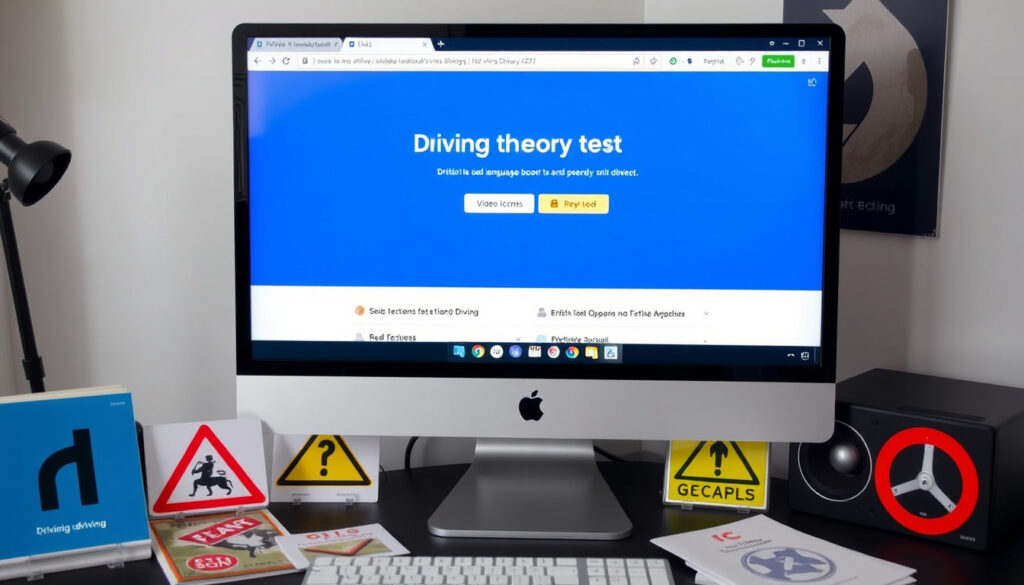
DVSA Theory Test BSL Accessibility: Guide & Options
If you’re a learner driver who uses British Sign Language, the theory test can feel more stressful than the actual driving. That’s changing — the DVSA now offers free BSL interpreters and on-screen video support at all test centres across England, Scotland, and Wales.
Pass mark (multiple-choice): 43 out of 50 · BSL interpreter: Available on request · Supported languages: English, Welsh, BSL · Reading support: Voiceover and extra time · Booking notice: At least 3 weeks for interpreter
Quick snapshot
- BSL interpreters provided by DVSA at no extra fee (GOV.UK official guidance)
- On-screen BSL videos appear next to questions during the test (GOV.UK Despatch Blog)
- Between April 2024 and March 2025, 1,800+ tests used on-screen BSL and 363 used live interpreters (Driving.org)
- Exact wait times for BSL interpreter availability vary by region
- BSL tool usage statistics post-May 2025 not yet published
- Specific Scotland-specific accessibility variations underexplored
- May 2025: DVSA launched first government-integrated BSL booking tool (GOV.UK Despatch Blog)
- 2021: Booking system relaunched with accessibility improvements (GOV.UK Despatch Blog)
- DVSA plans expanded BSL video library for more test topics
- Regional training for test centre staff on BSL assistance protocols
The following table summarizes key accessibility features available to theory test candidates with disabilities or learning difficulties.
| Feature | Availability |
|---|---|
| BSL Availability | Yes, with interpreter |
| Voiceover Support | For reading issues |
| Extra Time | Up to double duration |
| Pass Mark | 43/50 + 44/75 |
| UK BSL Users | Approximately 151,000 |
| Annual Tests with Extra Support | 1,128,178 (April 2024–March 2025) |
| BSL Interpreter Fee | None |
Theory test: cars — If you have a reading difficulty, disability or health condition
The DVSA provides a range of accommodations for candidates who need them. These include on-screen BSL videos, voiceover audio for those with reading difficulties, extra time (up to double the standard duration), paper test options, and live BSL interpreters. The theory test includes 50 multiple-choice questions and 14 hazard perception clips, with a pass mark of 43 correct answers on the multiple-choice section and 44 out of 75 on hazard perception.
Reading difficulties
If you have dyslexia or another reading difficulty, you can request a voiceover that reads questions aloud in English or Welsh. According to GOV.UK guidance, lip speakers or hearing loops are available at no extra fee — simply request them during booking. For those with severe language comprehension issues, the Official Learning Material (OLM) test variant is available but requires evidence of the condition.
Dyslexia accommodations typically require supporting documentation such as a GP letter or school statement. The DVSA booking system allows digital upload of medical evidence and ID, making the process more straightforward.
- Voiceover audio in English or Welsh
- Extra 20 minutes (or more with evidence)
- Paper test option available
- BSL on-screen videos for deaf candidates
The implication is that candidates with dyslexia should gather supporting documentation early, as the booking process requires evidence before accommodations can be confirmed.
Disabilities
Candidates with physical or sensory disabilities can access several support options. BSL users number approximately 151,000 in the UK, and the DVSA is the first government service to embed BSL translation directly into its digital platforms. On-screen BSL videos appear next to questions during the test at no additional cost. No proof of hearing difficulties is required for face-to-face BSL interpreter requests — candidates simply tick a box during online booking.
For candidates who are deaf or hard of hearing, lip speakers or hearing loops can be arranged. The DVSA provides these facilities free of charge upon request at the time of booking.
The catch is that the low uptake of BSL support — fewer than 2,200 tests used some form of BSL between April 2024 and March 2025 — suggests many eligible candidates remain unaware that free assistance is available.
Health conditions
Candidates with health conditions that affect test-taking can apply for reasonable adjustments. This includes extra time, separate rooms, or modifications to how the test is presented. The DVSA’s booking system allows candidates to indicate their needs, with supporting evidence uploaded digitally for conditions requiring medical documentation.
According to GOV.UK guidance, candidates can book a live BSL interpreter or deaf relay interpreter for the test at no extra fee. Deaf relay interpreters work alongside BSL interpreters to translate into candidate-understandable signs, ensuring full access to the test material.
Can you do the UK theory test in a different language?
Beyond English and Welsh, the DVSA offers the theory test only in British Sign Language. There is no option to take the test in other spoken languages such as Urdu, Punjabi, or Polish. BSL is treated as a full language accommodation, with both on-screen video support and live interpreter options available.
BSL support
BSL users can access the theory test through two main routes. The first is on-screen BSL videos that appear alongside questions automatically — no request needed beyond ticking the BSL box during booking. The second is a live BSL interpreter provided by the DVSA at the test centre, who will sign questions and answers in real time. According to research from Disability Driving Instructors, no proof of hearing difficulties is required for face-to-face BSL interpreter access — candidates simply request it during booking.
The DVSA launched the first government-integrated BSL booking tool on 19 May 2025, developed in partnership with the Government Digital Service (GDS), Kainos, and Signly. This tool allows candidates to switch on BSL support directly at gov.uk/book-theory-test, with a Signly interpreter explaining available options on the booking page.
English and Welsh
The standard theory test is available in English and Welsh. Candidates can choose their preferred language when booking. For those who struggle with reading English, voiceover options provide audio support — the system reads questions aloud, allowing candidates to listen rather than read.
Booking process
To book with BSL support, candidates must use the online booking system at gov.uk/book-theory-test. During the booking flow, there is a specific section for special requirements. Ticking the BSL box activates on-screen video support; requesting a live interpreter requires a separate note in the booking comments. The DVSA recommends booking at least 3 weeks in advance to ensure interpreter availability.
For Northern Ireland, BSL on-screen runs alongside questions, and non-BSL interpreters can enter the test centre via customer services arrangements. According to NIDirect guidance, candidates in Northern Ireland should contact the DSA directly for specific accommodation arrangements.
The pattern shows that BSL support is treated more favourably than other accommodations — no proof is required, whereas dyslexia and other conditions typically need supporting documentation.
BSL is the only alternative language for the UK theory test. English and Welsh remain the written options; voiceover fills the gap for reading difficulties.
How to pass theory test with learning disabilities?
Learning disabilities — including dyslexia, ADHD, and autism — can be accommodated during the theory test. The key is requesting support at the time of booking and providing appropriate evidence where required. The DVSA’s aim is that every candidate has the confidence and support they need to succeed.
Types of support
Support options for candidates with learning disabilities include extra time (up to double the standard duration), voiceover audio for reading difficulties, separate room requests, and paper test formats. BSL support is also available for candidates who communicate better in sign language. According to GOV.UK, lip speakers or hearing loops are available at no extra fee upon request.
For dyslexia specifically, evidence like a GP letter or school statement is required for accommodations. This differs from BSL support, which requires no proof of hearing difficulties — candidates simply tick the relevant box during booking.
- Extra time (up to double duration)
- Voiceover for reading difficulties
- Paper test option
- BSL interpreter at no cost
- Separate room requests
Practice tips
Practice is essential for all candidates, but those with learning disabilities may benefit from additional preparation. The DVSA provides free theory test practice materials on GOV.UK. For BSL users, the Signly tool on the booking page helps explain available support before candidates commit to a test date.
BSL theory test practice resources are available through specialist websites, though the DVSA’s official materials remain the primary preparation source. Candidates using BSL can also bring a personal assistant or instructor for interpretation during the booking process, though this does not extend into the test itself.
Booking adjustments
When booking, candidates should indicate all required accommodations in the special requirements section. The DVSA booking system allows digital upload of medical evidence for conditions requiring documentation. According to Driving.org, the system relaunched in 2021 with enhanced accessibility features including extra time options and digital document uploads.
For candidates with ADHD or autism, accommodations like extra time and separate rooms help manage concentration and sensory considerations. The DVSA encourages candidates to discuss their specific needs when booking to ensure appropriate arrangements are in place before the test date.
The implication is that early disclosure of needs during booking gives the DVSA adequate time to arrange suitable accommodations, reducing test-day stress.
BSL users number approximately 151,000 in the UK, yet only 1,800+ tests used on-screen BSL between April 2024 and March 2025 — suggesting many candidates may not know support is available.
How many out of 40 to pass the theory test?
The theory test for cars consists of two parts: 50 multiple-choice questions and 14 hazard perception video clips. Pass marks differ between the two sections. The multiple-choice section requires 43 correct answers out of 50 (86%), while the hazard perception section requires 44 out of 75 marks.
Multiple-choice pass mark
The multiple-choice section is straightforward — candidates must answer 43 out of 50 questions correctly to pass. There is no partial credit or negative marking. The voiceover option reads each question and all answer options aloud, which some candidates find helps maintain focus.
Hazard perception
The hazard perception test presents 14 video clips showing various driving scenarios. Candidates must identify developing hazards quickly and accurately by clicking when they spot a potential danger. The pass mark is 44 out of 75, and unlike the multiple-choice section, this part is timed and cannot be paused.
Resit rules
If a candidate fails either part, both sections must be retaken. There is no partial pass that carries over between attempts. Candidates can book a retest immediately after failing, though the DVSA recommends adequate preparation time between attempts.
The catch is that candidates cannot compartmentalize their preparation — both the multiple-choice and hazard perception sections demand equal attention to avoid having to retake the entire test.
The 43/50 pass mark for multiple-choice is high — but the voiceover option means candidates who struggle with reading can listen instead, which many find easier to process.
What can I do if I can’t pass my theory test?
Failing the theory test is common — the DVSA processes around 2.5 million theory tests annually, and not all first attempts succeed. The good news is that candidates can retake as many times as needed, with accommodations available to help those who have struggled previously.
Resit options
There is no limit on theory test attempts. After failing, candidates can book another test immediately through GOV.UK. Each attempt costs the standard test fee. The key is identifying what went wrong — whether it was reading comprehension, hazard perception timing, or test anxiety — and addressing that specific weakness.
For BSL users who struggle with written English, the voiceover option or BSL interpreter can make a significant difference. Candidates who failed previously may not have been aware of available accommodations.
Additional support
If standard accommodations are insufficient, candidates can discuss additional support needs with the DVSA. This might include extended extra time, a separate room for reduced distraction, or modified test formats. The DVSA’s booking system accommodates these requests, though supporting evidence may be required.
Between April 2024 and March 2025, 1,128,178 theory tests were conducted with extra support — a significant proportion of the 2.5 million annual total. This shows the system supports a wide range of needs.
Common failure reasons
Research suggests multiple-choice questions most commonly failed relate to vehicle safety, road rules, and specific signage meanings. Hazard perception failures typically stem from clicking too early, clicking too late, or failing to click during developing hazards.
For BSL users, language comprehension in written English is a frequent challenge. The on-screen BSL videos appear alongside questions during the actual test, but candidates may benefit from BSL-aware practice materials when preparing.
Upsides
- Free BSL interpreter at all test centres
- No proof required for hearing difficulties
- Voiceover option for reading difficulties
- Extra time up to double duration
Downsides
- Booking requires 3+ weeks notice for interpreter
- Dyslexia needs GP/school evidence
- No languages beyond English, Welsh, and BSL
- Scotland-specific variations unclear
How to book BSL interpreter for DVSA theory test?
Booking a BSL interpreter for your theory test involves using the DVSA’s online booking system and requesting the accommodation in the special requirements section. The process takes about 10 minutes online, though you’ll need to plan ahead.
- Go to gov.uk/book-theory-test
- Create an account or log in
- Select your preferred test centre and time slot
- In the special requirements section, tick the BSL support box
- For a live interpreter, add a note in the booking comments requesting this
- Book at least 3 weeks ahead to ensure interpreter availability
- Confirm your booking via email
On-screen BSL videos require no additional booking — simply tick the BSL box and the feature activates automatically. Live interpreters must be arranged by the DVSA, which is why the advance notice requirement exists.
DVSA’s accessibility commitment means candidates with hearing difficulties receive the same test access as other learners, removing a barrier that previously discouraged many from attempting the theory test.
“DVSA’s priority is to ensure the theory test is accessible to everyone – we want learners to have the confidence and support they need to succeed.”
— DVSA official statement (GOV.UK Despatch Blog)
“The addition of a Signly BSL interpreter to the booking page helps explain what support is available and how to apply for it.”
— Accessibility commentator (Driving.org)
The DVSA is the first government service to embed BSL translation directly into its digital platforms, a milestone that reflects growing recognition of deaf community needs. Between April 2024 and March 2025, over 2,100 tests used some form of BSL support — on-screen videos or live interpreters combined. That figure represents a small fraction of the 151,000 BSL users in the UK, suggesting awareness remains a challenge. The May 2025 launch of the integrated booking tool aims to change that by making BSL support visible from the first step of the process.
Related reading: Renew Driving Licence at 70 · Car Garages Near Me
limpingchicken.com, disabilitydrivinginstructors.com, disabilitydrivinginstructors.com, theorytestpro.co.uk, bsltheorytest.co.uk, nidirect.gov.uk, disabilitydrivinginstructors.com
While BSL options enhance DVSA theory test accessibility, the comprehensive UK Driving Theory Test 2025 guide details booking processes, practice tips, and 2025 updates for all learners.
Frequently asked questions
What are the most failed questions on the theory test?
Questions on vehicle safety, road rules, and specific signage meanings are most commonly failed. Hazard perception failures typically involve mistiming clicks — either clicking too early or failing to identify developing hazards.
How to 100% pass your theory test?
There is no guaranteed pass method, but thorough preparation helps. Use official DVSA practice materials, focus on commonly failed topics, and request all available accommodations if you have a disability or learning difficulty.
Why do people say to eat a banana before a driving test?
Bananas contain vitamin B6 and potassium, which some believe helps reduce anxiety and muscle tension. However, this is folk wisdom rather than evidence-based advice. Adequate sleep and preparation remain the most effective test-day strategies.
What are the 8 types of learning disabilities?
Common learning disabilities include dyslexia (reading), dyscalculia (math), dysgraphia (writing), dyspraxia (motor skills), auditory processing disorder, language processing disorder, nonverbal learning disability, and executive function disorders.
How do I book a DVSA theory test with BSL support?
Go to gov.uk/book-theory-test, select your test centre and time, and tick the BSL support box in the special requirements section. For a live interpreter, add a note requesting this when booking. Book at least 3 weeks ahead.
Support for deaf and blind in theory test?
Deaf candidates can use BSL interpreters or on-screen BSL videos at no extra cost. Blind or visually impaired candidates may request extended time, modified formats, or a reader. Contact the DVSA directly for arrangements beyond standard accommodations.
More related posts
 Michael Aspel: Illness, Family, Career, and Current Life in 2025
 Beef Casserole Slow Cooker – Budget Recipe for Tender Beef
 Frank Warren: Biography, Net Worth, Shooting, Tyson Punch
 Emmylou Harris: Health, Career & Biggest Hit (2025)
 Holiday Wheelie Bin Fines UK: Key Rules and Penalties
 NatWest Online Banking App: Install & Use
 Thelo Aasgaard: Age, Dad, Transfer Fee, and Career Stats
 How Much Money Does Elon Musk Have? Net Worth 2026
